
Starting ABA therapy can feel like a big step for any family.
Parents often want to know what to expect from ABA therapy before their child begins. Will the first session be formal? Will the therapist start teaching right away? How are goals chosen? What happens if the child cries, avoids the room, or needs more time to feel comfortable?
These are normal questions.
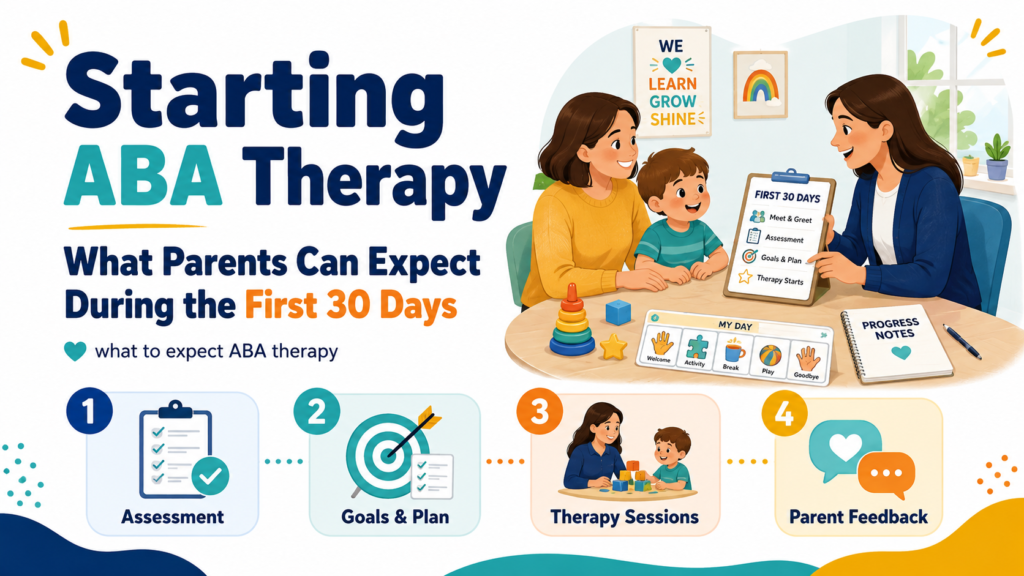
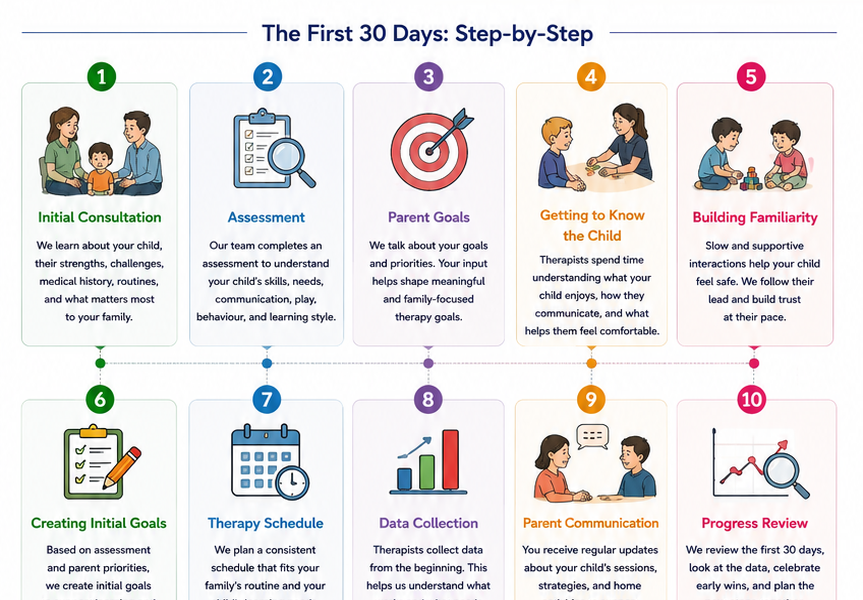
The first 30 days of ABA therapy are usually not about rushing a child into a full program. They are about understanding the child, learning what matters to the family, completing assessment, building familiarity, creating initial goals, setting a therapy schedule, collecting early data, and beginning communication between the therapy team and parents.
For families in Ontario, the Ontario Autism Program explains that families receiving core clinical services work with a qualified professional to complete a clinical assessment and develop a treatment plan based on the child and family’s strengths, support needs, and goals.
This guide explains what parents can usually expect during the first 30 days of ABA therapy and how a child-centred process can help build a strong foundation.
The First 30 Days Are About Understanding, Not Rushing
Every child starts therapy differently.
Some children enter the room and begin playing right away. Some stay close to their parent. Some avoid the therapist at first. Some need time to explore the space. Some communicate through words, gestures, pictures, movement, or behaviour.
A good first month should make space for this.
The first 30 days are usually focused on:
Understanding the child’s strengths and needs
Learning family priorities
Completing assessment
Observing communication and behaviour patterns
Building trust with the child
Creating early therapy goals
Setting a realistic therapy schedule
Starting data collection
Communicating with parents
Reviewing what is working
Adjusting the plan if needed
ABA therapy should not feel like a one-size-fits-all program. Ontario’s 2026–2027 service objectives describe Ontario Autism Program core clinical services as evidence-informed services that should respond to a child or youth’s unique strengths, needs, opportunities, and goals.
Step 1: Initial Consultation
The initial consultation is usually the first conversation between the family and the provider.
This is where parents can share:
Why they are seeking support
What daily routines feel difficult
What their child enjoys
How their child communicates
What behaviours are concerning
What has helped in the past
What has not helped
What goals matter most to the family
Any school, daycare, or home concerns
The consultation should not feel like an interrogation. It should feel like a conversation.
Parents may ask:
What will the first month look like?
Who will work with my child?
Who supervises the program?
How are goals created?
How often will we receive updates?
How can we raise concerns?
What happens if my child needs more time?
A good provider should welcome these questions.
Step 2: ABA Assessment
Before creating a therapy plan, the team needs to understand the child.
An ABA assessment may include parent interviews, direct observation, play-based interaction, review of current skills, and discussion of family priorities.
The goal is to understand how the child learns, communicates, responds to instructions, plays, handles transitions, expresses needs, and participates in daily routines.
Assessment may look at areas such as:
Communication
Play skills
Social interaction
Daily living skills
Transitions
Emotional regulation
Safety skills
Learning readiness
Behaviour patterns
Parent priorities
In Ontario, AccessOAP explains that clinical assessment is completed as part of the first step of treatment planning and delivery of core clinical services.
Parents should ask how the assessment will be explained to them in plain language.
Step 3: Parent Goals and Family Priorities
Parent goals matter.
A therapy plan should not only focus on what a child does in a clinic. It should connect to real life.
Parents may want support with:
Morning routines
Leaving the house
Mealtime
Toilet training
Communication
Following directions
Playing with siblings
School readiness
Transitions
Safety
Emotional regulation
Reducing distress
Building independence
For example, a parent may say:
“I want my child to ask for help instead of crying.”
Or:
“I want after-school routines to feel calmer.”
Or:
“I want my child to follow a simple bathroom routine.”
These are meaningful goals because they connect therapy to the child’s everyday life.
Step 4: Getting to Know the Child
The therapist’s first job is not only to teach. It is also to understand the child.
During the first days, the therapist may spend time observing:
What the child likes
What motivates the child
How the child communicates
What feels hard
What helps the child feel calm
How the child responds to play
How the child responds to adults
What the child avoids
What skills already exist
Some children may need play, movement, sensory breaks, familiar toys, parent presence, or slower transitions before they feel ready to engage.
This is part of the process.
Step 5: Building Familiarity and Trust
A child may not feel comfortable immediately.
That is okay.
The first month should include time to build familiarity with the therapist, space, routine, and expectations.
This may include:
Exploring the room
Playing with preferred toys
Following the child’s lead
Keeping demands low at first
Using short interactions
Offering breaks
Allowing parent support
Building positive associations
Watching for signs of stress
Celebrating small steps
Building familiarity helps the child understand that therapy is a safe and supportive place.
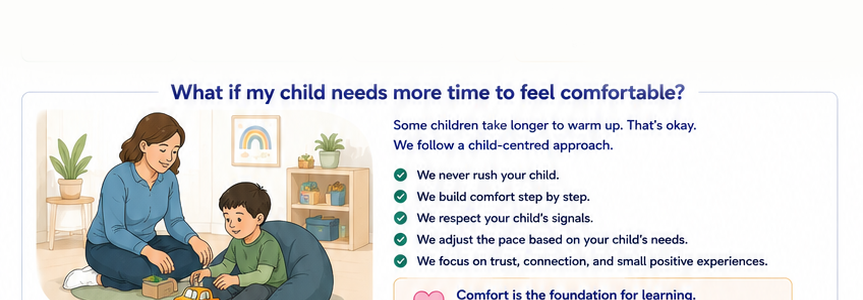
What if My Child Needs More Time to Feel Comfortable?
Some children need more time to warm up.
That does not mean ABA therapy is failing. It may simply mean the child needs a slower start.
A child may need more time if they:
Stay close to a parent
Avoid entering the therapy room
Cry during transitions
Refuse unfamiliar toys or activities
Do not respond to the therapist at first
Need the same routine each session
Become overwhelmed by new people
Use behaviour to communicate discomfort
A child-centred team should notice these signs and adjust the pace.
This may mean shorter expectations, more play, fewer demands, parent involvement, sensory supports, or more time spent building trust before moving into structured goals.
The goal is not to force comfort.
The goal is to build it.
A child who walks into the room calmly is making progress.
A child who plays near the therapist is making progress.
A child who accepts one simple interaction is making progress.
A child who communicates “no,” “help,” or “break” is making progress.
Small steps matter.
Step 6: Creating Initial Goals
After consultation, assessment, parent input, and early observation, the team can begin creating initial therapy goals.
These goals should be specific, meaningful, and connected to the child’s life.
Initial goals may focus on:
Requesting help
Following simple routines
Tolerating transitions
Using communication tools
Building play skills
Increasing independence
Reducing distress
Developing safety skills
Improving participation
Supporting parent routines
The Ontario Autism Program says core clinical services can include service categories such as Applied Behaviour Analysis, speech-language pathology, occupational therapy, and mental health services.
That matters because some children may need ABA only, while others may benefit from a team approach involving Speech Therapy, Occupational Therapy, or Psychotherapy as well.
Step 7: Therapy Schedule
During the first 30 days, the provider and family usually discuss the therapy schedule.
This may include:
How many sessions per week
How long each session will be
Where therapy will happen
Whether parent coaching is included
Whether school or daycare goals are relevant
Whether in-centre or in-home support is needed
How the schedule fits family routines
The best schedule is not always the busiest schedule.
It should make sense for the child’s needs, family capacity, funding, and clinical recommendations.
Parents should ask:
Why is this schedule recommended?
How will we know if it is too much or too little?
Can the schedule change?
How are breaks handled?
What happens if my child becomes overwhelmed?
Step 8: Data Collection Begins
ABA therapy uses data to understand whether strategies are working.
Data does not have to feel cold or clinical. It is simply a way to track progress and make informed decisions.
Therapists may collect information on:
How often a skill happens
How much help the child needs
How the child responds to prompts
How long a behaviour lasts
What happens before and after behaviour
Whether the child uses the skill in different places
Whether a strategy is helping or needs to change
Parents should not feel excluded from this process.
Ask:
What data are you collecting?
How will you explain it to us?
How often will we review it?
What happens if the data shows limited progress?
Can parent observations be included?
Good data should help the team make better decisions.
Step 9: Parent Communication
Parent communication should begin early.
Parents should know what happened in sessions, what the child is working on, what progress has been seen, and what can be practised at home.
Communication may include:
Session notes
Brief verbal updates
Parent meetings
Progress summaries
Home strategies
Email updates
Goal review discussions
Parent coaching
Ontario service objectives for core clinical services include enhancing the capacity of parents and caregivers, including their knowledge and skill in using support strategies.
That means parent involvement is not extra. It is part of meaningful support.
Parents can ask:
Who will update me?
How often will updates happen?
Can I ask questions between sessions?
Will I receive home strategies?
How will you explain progress?
What should I do if something is not working at home?
Step 10: Progress Review
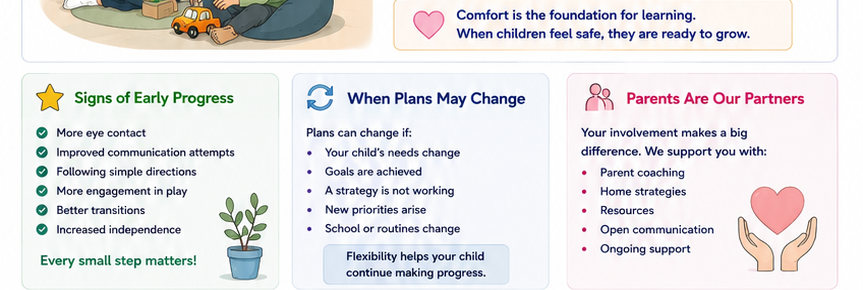
By the end of the first 30 days, the team should begin reviewing what has been learned.
This may include:
What the child enjoys
What helps the child feel comfortable
Which goals are appropriate
What data shows so far
What strategies are working
What strategies need adjustment
How the child responds to the schedule
What parents are noticing at home
What the next steps should be
Progress review should not be only about numbers.
It should also include the child’s comfort, communication, family experience, and whether the plan feels practical.
When Plans May Change
ABA therapy plans should not be frozen.
Plans may change when:
A child’s needs change
A goal is achieved
A strategy is not working
A child needs more time
A family routine changes
School or daycare concerns arise
The child becomes distressed
New priorities appear
Data suggests a different approach is needed
Changing the plan is not a failure.
It is part of responsive care.
A thoughtful provider should adjust the plan based on the child’s progress, comfort, and needs.
What Parents Can Do During the First 30 Days
Parents can support the first month by:
Sharing honest information about their child
Asking questions early
Telling the team what works at home
Mentioning what causes stress
Noticing small wins
Practising suggested strategies
Giving feedback if something feels too difficult
Communicating schedule concerns
Keeping expectations realistic
Celebrating progress, not perfection
Parents are not just observers.
They are partners.
Signs of Early Progress
Progress in the first 30 days may look small, but small steps are important.
Early progress may look like:
Entering the therapy room more calmly
Looking at the therapist
Accepting play near the therapist
Using one new communication attempt
Tolerating a transition
Following one simple routine
Needing less support for a task
Recovering faster after frustration
Showing interest in an activity
Parent feeling more informed and supported
Not every child will show dramatic change in the first month. That is normal.
The first 30 days are about building a foundation.
Questions Parents Should Ask During the First Month
Parents can ask:
What did you learn about my child this week?
What goals are we starting with?
How are parent priorities included?
How are you measuring progress?
How often will we review the plan?
What should we practise at home?
What if my child seems overwhelmed?
Can we slow down if needed?
How will you communicate changes?
When will we review the first 30 days?
A good provider should welcome questions and answer them clearly.
How SpectacoKids Supports Families Starting ABA Therapy
SpectacoKids provides ABA Therapy, Speech Therapy, Occupational Therapy, Psychotherapy, Respite Care, Camps, and Group Classes for children and families. Services are available in-centre and in-home across Milton, Mississauga, Oakville, and Burlington.
For families starting ABA therapy in Milton Ontario or ABA therapy Mississauga, the first month is an important time to build trust, understand the child, include parent goals, create initial plans, and begin progress review.
Families in Milton and Mississauga can contact SpectacoKids to learn more about our ABA services and care process.
Image Placement 5: Add CTA Section Image Here
Use: spectacokids-starting-aba-cta-section.png
Alt text: SpectacoKids ABA therapy support for families in Milton and Mississauga.
Conclusion
Starting ABA therapy does not have to feel confusing.
During the first 30 days, parents can expect consultation, assessment, parent goal-setting, time spent getting to know the child, initial goals, a therapy schedule, data collection, communication, and progress review.
Some children may need more time to feel comfortable, and that should be respected.
The goal of the first month is not to rush. It is to understand the child, support the family, and create a plan that can grow with the child’s needs.
Contact SpectacoKids
Website: www.spectacokids.com
Email: info@spectacokids.com
Phone: +1 647-996-4409
Locations:
Milton Centre
Unit 202 – 61 James Snow Pkwy N, Milton, ON L9E 0H1
Mississauga Centre
3353 The Credit Woodlands, Unit 5, Mississauga, ON L5C 2K1
Mississauga Centre
Unit 52 – 1077 N Service Rd, Mississauga, ON L4Y 1A6
Suggested Internal Links to Add in WordPress
ABA Therapy
Meet the Team
Contact
Milton location
Mississauga location
Speech Therapy
Occupational Therapy
FAQ Section
What should parents expect during the first ABA session?
The first ABA session may focus on helping the therapist get to know the child, observing communication and play, building comfort, and understanding what helps the child feel safe and engaged. It may not immediately look like a full structured therapy program.
How long does it take for a child to adjust to ABA therapy?
Every child is different. Some children adjust quickly, while others need more time to feel comfortable with the therapist, room, routine, and expectations. A child-centred provider should adjust the pace when needed.
What happens during an ABA assessment for a child?
An ABA assessment may include parent interviews, observation, play-based activities, review of communication, behaviour patterns, daily living skills, and family goals. The assessment helps guide the treatment plan.
Are parents involved in the first 30 days of ABA therapy?
Yes. Parents should be involved in sharing goals, giving background information, asking questions, receiving updates, and learning strategies that may help at home.
How is progress measured in ABA therapy?
Progress may be measured through data collection, observation, parent feedback, and review of how the child uses skills across settings. Data helps the team decide whether strategies are working or need to change.
Can the ABA therapy plan change after the first month?
Yes. ABA therapy plans may change when the child’s needs, goals, comfort level, data, family priorities, or school routines change. Plan adjustments are part of responsive care.