
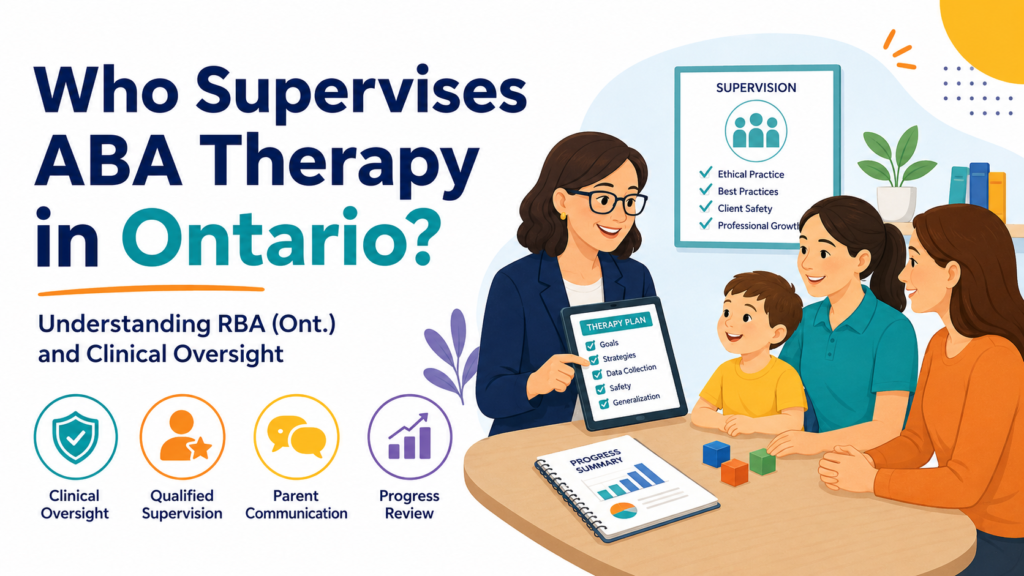

When parents search for RBA Ontario or ABA supervision in Ontario, they are usually trying to understand one important question:
Who is actually responsible for my child’s ABA therapy plan?
This is a fair and important question.
ABA therapy may involve more than one professional. A child may work directly with a front-line therapist, but the program may be developed, monitored, reviewed, and adjusted by a clinical supervisor. In Ontario, families should understand the role of a Registered Behaviour Analyst, often written as RBA (Ont.), and how professional oversight works.
Clinical supervision does not mean every challenge disappears. It also does not “guarantee safety.”
A better way to understand it is this:
Clinical supervision provides professional oversight, review, and accountability.
This blog explains what RBA (Ont.) means, the difference between a therapist and a clinical supervisor, who develops treatment plans, who reviews progress, how parents should receive updates, and what questions families can ask before starting ABA therapy in Ontario.
Why ABA Supervision Matters for Ontario Families
ABA therapy is not only about one-to-one sessions.
A strong ABA program should include assessment, goal planning, teaching strategies, progress review, parent communication, and adjustments when something is not working.
Ontario’s Autism Program guidelines say ABA services must be delivered and/or supervised by a behaviour analyst, psychologist, or psychological associate who is registered and in good standing with the College of Psychologists and Behaviour Analysts of Ontario. The same guidance explains that families work with their chosen clinician to develop a treatment plan based on the child’s current needs and priority goals. (ontario.ca)
That means parents should know who is clinically responsible for the program.
They should also know how that person reviews the child’s goals, data, progress, communication needs, safety concerns, and family priorities.
Good supervision helps ensure therapy is not just happening, but being thoughtfully planned and reviewed.
What Does RBA (Ont.) Mean?

RBA (Ont.) stands for Registered Behaviour Analyst in Ontario.
As of July 1, 2024, Behaviour Analysts became regulated health professionals in Ontario under the College of Psychologists and Behaviour Analysts of Ontario. Ontario’s Psychology and Applied Behaviour Analysis Act says that no person other than a member of the College may use the title “behaviour analyst,” or a variation or abbreviation of that title. (ontario.ca)
The College of Psychologists and Behaviour Analysts of Ontario also explains that only ABA practitioners registered with the College may use the title “Behaviour Analyst” in Ontario beginning July 1, 2024. (cpbao.ca)
For parents, this matters because the title is no longer just a general job description.
It is connected to regulation, professional standards, and public accountability.
Parents can ask:
Is the clinical supervisor an RBA (Ont.)?
Are they registered with CPBAO?
Are they authorized for autonomous practice or supervised practice?
Can I verify their registration?
What role do they play in my child’s treatment plan?
A transparent provider should be comfortable answering these questions.
What Is the Difference Between a Therapist and a Clinical Supervisor?

In many ABA programs, the person working directly with your child every session may not be the same person who designs and supervises the clinical plan.
This is not automatically a problem. It is common for care to involve different roles.
But parents should understand the difference.
The Front-Line Therapist
A front-line therapist may deliver the one-to-one sessions. They may work directly with the child on communication, play, routines, social skills, daily living skills, or behaviour support goals.
They may:
Run teaching programs
Collect session data
Use strategies from the treatment plan
Support the child during activities
Communicate daily updates
Ask the supervisor questions
Report concerns or changes
The therapist should be trained, supported, and monitored.
The Clinical Supervisor
The clinical supervisor is responsible for oversight of the program.
Depending on the provider and service model, this may be an RBA (Ont.), psychologist, or psychological associate with appropriate scope and qualifications.
The clinical supervisor may:
Assess the child’s needs
Develop treatment goals
Create or approve the treatment plan
Train therapists
Review data
Observe sessions
Update strategies
Meet with parents
Review progress
Respond to concerns
Ensure the program is clinically appropriate
Ontario’s older OAP service documentation also described front-line therapists as responsible for implementing the services outlined in the behaviour plan while receiving training and clinical supervision from the clinical supervisor. (ontario.ca)
The key point for parents is simple:
The therapist may deliver the session, but the clinical supervisor should provide professional oversight, review, and accountability.
Who Develops ABA Treatment Plans?
Treatment plans should not be generic.
A child’s ABA plan should be based on their strengths, needs, family priorities, communication style, learning profile, daily routines, and current challenges.
Ontario’s OAP guidance says that when families receive OAP funding, they work with their chosen clinician or clinicians to develop a treatment plan, which may include a clinical assessment of the child’s current needs and priority goals. (ontario.ca)
Parents can ask:
Who completes the assessment?
Who chooses the goals?
Who writes or approves the treatment plan?
How are family priorities included?
How are school, home, and community needs considered?
How does the supervisor decide what to work on first?
Can goals be changed if they are not useful?
A good treatment plan should answer the question:
How will this help the child in real life?
For example, a useful goal may support:
Requesting help
Tolerating transitions
Communicating needs
Following a daily routine
Playing with siblings
Participating at school
Building self-care skills
Reducing distress during difficult tasks
If goals do not make sense to the family, parents should ask for clarification.
Who Reviews Progress?

Progress review is one of the most important parts of clinical supervision.
ABA therapy usually involves collecting information about how the child is responding to teaching strategies. This may include data on skill use, independence, communication, behaviour patterns, prompts, generalization, or how often a goal is being met.
The clinical supervisor should review progress and decide whether the plan is working.
Parents can ask:
What data is collected?
Who reviews the data?
How often is progress reviewed?
How will I receive updates?
What happens if progress slows down?
What happens if my child becomes more distressed?
How do you decide when to change a strategy?
How do you know a goal is achieved?
How do you help my child use the skill outside therapy?
Progress should not only be measured by what happens inside the therapy room.
Parents should also ask whether the child is using the skill at home, school, daycare, or in the community.
A child may learn to request “help” in a session, but the larger goal is for the child to request help during real life moments.
Why Supervision Matters
ABA supervision matters because children’s needs can change.
A strategy that worked last month may not work now.
A child may achieve a goal and need a new one.
A behaviour may increase and need review.
A family routine may change.
A child may start school or daycare.
A new communication need may appear.
A therapist may need additional coaching.
Parents may have concerns that need a thoughtful response.
Clinical supervision provides professional oversight, review, and accountability.
It helps ensure the program is not running on autopilot.
It also gives families a clearer path for asking questions, reviewing goals, and understanding how decisions are made.
How Often Should Parents Receive Updates?
There is no single update schedule that fits every child and every provider.
However, parents should not feel disconnected from their child’s ABA therapy.
Before starting, ask what communication will look like.
Parents can ask:
Will I receive updates after every session?
Will I receive weekly or monthly summaries?
How often can I meet with the supervisor?
Will I see data or progress notes?
Who do I contact if I have a concern?
How quickly should I expect a response?
Will updates include what worked and what did not work?
Will I learn strategies to use at home?
A strong provider should set clear communication expectations from the beginning.
Updates should be understandable. Parents should not need clinical training to understand whether their child is making progress.
What Questions Should Parents Ask About ABA Supervision?
Here is a parent-friendly list to use before starting ABA therapy.
Questions About Credentials
What is the name of the clinical supervisor?
Are they an RBA (Ont.), psychologist, or psychological associate?
Are they registered and in good standing with CPBAO?
Can I verify their registration on the CPBAO public register?
Are they authorized for autonomous practice or supervised practice?
Questions About Supervision
How often does the supervisor observe sessions?
How often do they review data?
How do they train therapists?
How do they respond when something is not working?
How do parents request a supervision meeting?
Questions About the Therapist
What training does the therapist have?
Who supervises the therapist?
How often is the therapist observed?
What should the therapist do if my child becomes distressed?
How is dignity, communication, and comfort protected?
Questions About Treatment Planning
Who develops the treatment plan?
How are goals selected?
How are family priorities included?
How are goals reviewed?
Can goals be changed?
Questions About Progress
How will progress be measured?
How often will I receive updates?
Will I see written reports?
How will I know if therapy is working?
What happens if progress slows or stops?
Questions About Concerns
Who do I contact with concerns?
How are concerns documented?
How quickly will someone respond?
Can I request a supervisor meeting?
What happens if I disagree with a strategy?
These questions are not meant to challenge the provider.
They help build trust.
A strong provider should welcome informed parents.
How Can Parents Verify Credentials?
Parents can verify professional registration through the CPBAO public register.
CPBAO says information about a psychologist, psychological associate, or behaviour analyst can be found in its searchable Public Register or obtained from the College. (cpbao.ca)
Parents can ask the provider for:
Full name of the supervisor
Professional title
College registration status
Registration class
Whether they are in good standing
Whether there are any terms, conditions, or limitations
You do not need to guess based on job titles on a website.
Use the official register when possible.
What Does Professional Accountability Mean?
Professional accountability means a regulated professional is accountable to their College and must meet professional requirements, standards, and expectations.
It does not mean a provider is perfect.
It does not mean a child will never have a difficult session.
It does not mean supervision guarantees safety.
But it does mean there is a professional oversight system beyond the individual clinic.
The College regulates psychologists, psychological associates, and behaviour analysts in Ontario, and the provincial law restricts use of these protected titles to College members. (ontario.ca)
For parents, this matters because it creates a clearer route for:
Checking credentials
Understanding professional roles
Asking informed questions
Knowing who is responsible for clinical oversight
Raising concerns when needed
Professional accountability is one part of trust.
Clear communication, parent involvement, child-centred practice, and transparency also matter.
Supervision Red Flags Parents Should Notice
Parents should pay attention if a provider:
Will not name the clinical supervisor
Cannot explain who creates the plan
Cannot explain who reviews progress
Uses “supervised” without explaining what that means
Does not allow parents to ask questions
Does not provide clear updates
Cannot explain therapist qualifications
Discourages credential checking
Does not discuss parent involvement
Avoids explaining how concerns are handled
Does not review goals regularly
Focuses only on compliance without discussing communication, dignity, and regulation
If something feels unclear, ask.
If the answer still feels unclear, pause before starting.
How SpectacoKids Supports Families
SpectacoKids provides ABA Therapy, Speech Therapy, Occupational Therapy, Psychotherapy, Respite Care, Camps, and Group Classes for children and families. The official website lists ABA, Speech, and Occupational Therapy under one roof, in-centre and in-home across Milton, Mississauga, Oakville, and Burlington. (spectacokids.com)
For families exploring ABA therapy in Milton Ontario or ABA therapy Mississauga, supervision, communication, and parent involvement are important questions to ask before starting services.
Families can also review SpectacoKids’ ABA Therapy page, Meet the Team page, Contact page, Milton location details, and Mississauga location details when learning more about the care process. (spectacokids.com)
Families in Milton and Mississauga can contact SpectacoKids to learn more about our ABA services and care process.
Conclusion
Understanding ABA supervision in Ontario helps parents make more informed decisions.
An RBA (Ont.) is a Registered Behaviour Analyst in Ontario, and Behaviour Analysts are now regulated through the College of Psychologists and Behaviour Analysts of Ontario.
Parents should know the difference between a front-line therapist and a clinical supervisor, who develops the treatment plan, who reviews progress, how often updates happen, how credentials can be verified, and how concerns can be raised.
Clinical supervision provides professional oversight, review, and accountability.
When families understand the supervision structure, they can ask better questions, participate more confidently, and choose services with greater clarity.
Contact SpectacoKids
Website: www.spectacokids.com
Email: info@spectacokids.com
Phone: +1 647-996-4409
Locations:
Milton Centre
Unit 202 – 61 James Snow Pkwy N, Milton, ON L9E 0H1
Mississauga Centre
3353 The Credit Woodlands, Unit 5, Mississauga, ON L5C 2K1
Mississauga Centre
Unit 52 – 1077 N Service Rd, Mississauga, ON L4Y 1A6
SpectacoKids lists its contact information, free consultation option, services, and centre locations on the official website. (spectacokids.com)
Suggested Internal Links to Add in WordPress
ABA Therapy
Meet the Team
Contact
Milton location
Mississauga location
FAQ Section
What does RBA (Ont.) mean?
RBA (Ont.) means Registered Behaviour Analyst in Ontario. Behaviour Analysts are regulated by the College of Psychologists and Behaviour Analysts of Ontario, and the title “Behaviour Analyst” is restricted to College members in Ontario.
Who supervises ABA therapy in Ontario?
Under Ontario Autism Program guidance, ABA services must be delivered and/or supervised by a behaviour analyst, psychologist, or psychological associate who is registered and in good standing with the College of Psychologists and Behaviour Analysts of Ontario.
What is the difference between an ABA therapist and a clinical supervisor?
An ABA therapist may deliver direct sessions with the child, while the clinical supervisor oversees assessment, treatment planning, therapist training, data review, progress monitoring, and clinical decision-making.
Who develops ABA treatment plans?
Treatment plans should be developed by the chosen clinician or clinical team based on the child’s assessment, current needs, strengths, and priority goals, with family involvement.
How can parents verify RBA Ontario credentials?
Parents can ask for the supervising clinician’s full name and professional title, then search the CPBAO Public Register to verify registration status.
Does supervision guarantee safety?
No. It is better to say clinical supervision provides professional oversight, review, and accountability. Parents should still ask about safety, communication, reporting, transparency, and how concerns are handled.
References to Add Manually in WordPress
SpectacoKids official website, ABA Therapy page, Meet the Team page, and Contact page
Written by: SpectacoKids Editorial Team