
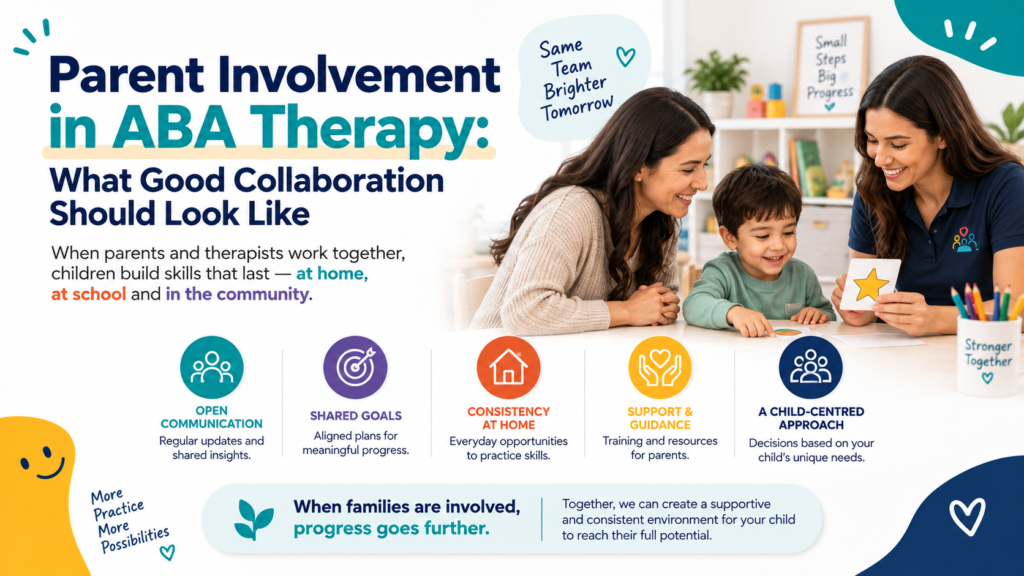
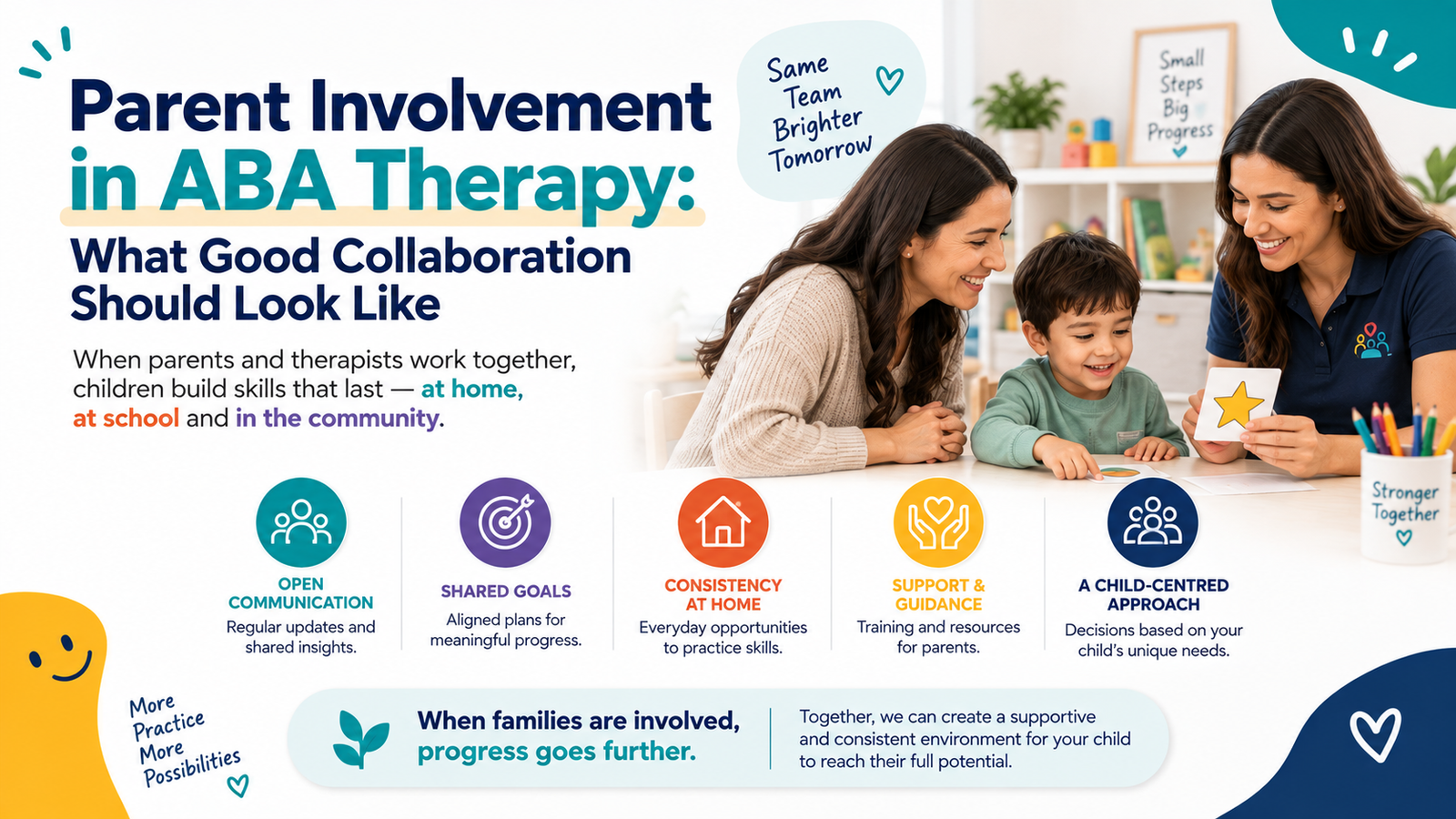
Parent involvement in ABA therapy can make the care process more meaningful, more practical, and more connected to real life.
A child may practise a skill during therapy, but that skill becomes more powerful when it also helps at home, at school, during routines, with siblings, and in the community.
That is why good ABA therapy should not feel like something that happens behind closed doors while parents wait outside.
Parents know their child’s routines, strengths, stress points, preferences, communication style, and family priorities. Therapists bring clinical knowledge, observation, planning, teaching strategies, and progress tracking. When both sides work together, therapy can become more useful for the child and the family.
Ontario’s Autism Program describes core clinical services as evidence-informed services that should respond to a child’s unique strengths, needs, opportunities, and goals. It also includes family and caregiver capacity-building as part of support.
Why Parent Involvement in ABA Therapy Matters
ABA therapy is not only about what happens in a session.
It is also about how skills carry over into everyday life.
A child may learn to request help during a structured activity, but parents may need that same skill during getting dressed, mealtime, homework, grocery shopping, bedtime, or school drop-off.
A child may practise waiting during therapy, but the family may need support using that skill in a doctor’s office, playground, car ride, or birthday party.
This is why parent involvement matters.
Good collaboration can help:
Make goals more relevant
Connect therapy to real routines
Help parents understand what is being taught
Support consistency across home and therapy
Give therapists important context
Identify what is and is not working
Adjust goals when needed
Build parent confidence
Make progress easier to use outside the clinic
CanChild describes family-centred service as an approach that recognizes parents as experts on their child’s needs, promotes partnership between parents and service providers, and supports families in decision-making.
What Good Collaboration in ABA Therapy Looks Like
Good collaboration does not mean parents have to become therapists.
It means parents are included, informed, respected, and supported.
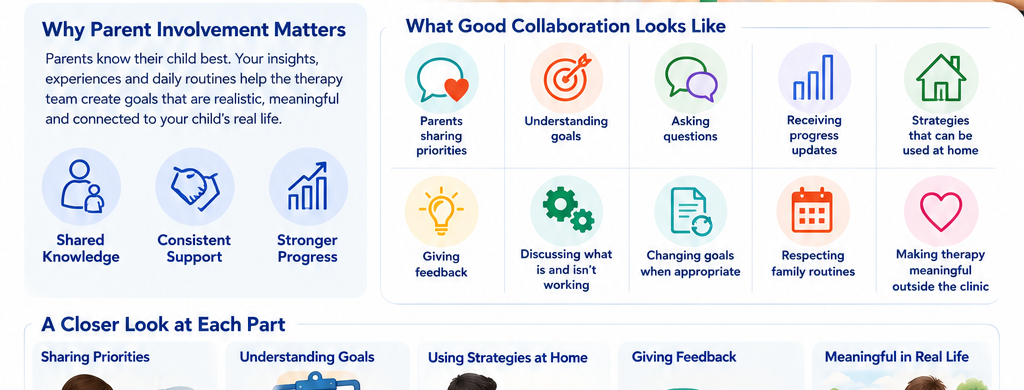
Strong parent involvement in ABA therapy may include:
Parents sharing priorities
Parents understanding goals
Parents asking questions
Parents receiving progress updates
Parents learning strategies for home
Parents giving feedback
Parents discussing what is and is not working
Goals changing when appropriate
Family routines being respected
Therapy becoming meaningful outside the clinic
The best collaboration feels like a team.
Not a handoff.
Not a lecture.
Not a one-way report.
A real partnership.
1. Parents Sharing Priorities
Parents should have space to explain what matters most for their child and family.
A parent may say:
“I want mornings to feel calmer.”
“I want my child to ask for help instead of crying.”
“I want them to be safer in public.”
“I want mealtimes to feel less stressful.”
“I want my child to play more comfortably with siblings.”
“I want school transitions to feel easier.”
These priorities matter because therapy goals should connect to real life.
A goal that looks good in a report but does not help the family’s daily routine may need to be reviewed.
Good ABA collaboration starts by asking:
What is hard right now?
What would make daily life easier?
What does your child already do well?
What matters most to your family?
2. Understanding Goals
Parents should understand what their child is working on and why.
If a child is working on requesting, parents should know what that means. If a child is working on transitions, parents should understand how that goal connects to everyday routines. If a child is working on waiting, parents should know how to support it at home.
Good goals should be explained in plain language.
For example:
Clinical wording may say:
“Increase functional communication.”
Parent-friendly wording may say:
“Help your child ask for help, breaks, or preferred items in a way others can understand.”
Clinical wording may say:
“Improve transition tolerance.”
Parent-friendly wording may say:
“Help your child move from one activity to another with less distress.”
Parents should never feel embarrassed asking for an explanation.
3. Asking Questions
Parents should feel comfortable asking questions at any point in the process.
Questions are not disrespectful. They are part of good care.
Parents can ask:
Why are we working on this goal?
How will we know whether it is helping?
What can I practise at home?
What should I tell you if something is not working?
How often will I receive progress updates?
Can we adjust the goal if needed?
How does this connect to our daily routines?
What do you see as the next step?
A transparent provider should welcome these questions.
The goal is not for parents to challenge every decision. The goal is for parents to understand the plan well enough to support their child confidently.
Questions Parents Should Feel Comfortable Asking
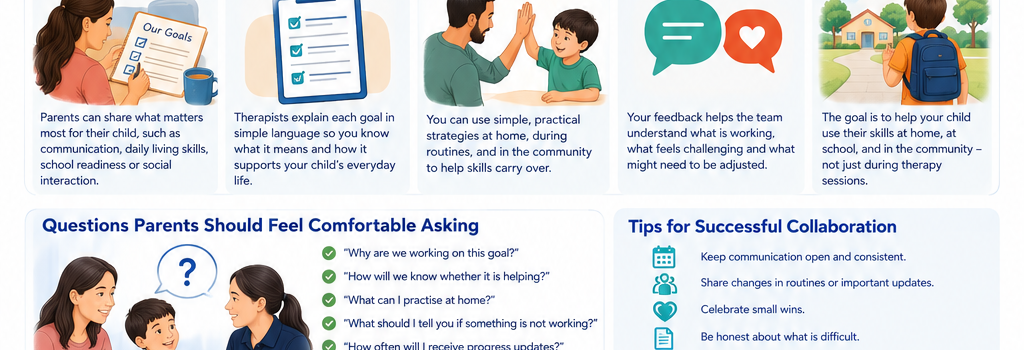
Here are simple questions parents can bring to a meeting, progress review, or consultation.
“Why are we working on this goal?”
This helps parents understand the purpose behind the goal.
A good answer should connect the goal to the child’s communication, independence, safety, daily routines, learning, or quality of life.
“How will we know whether it is helping?”
This helps parents understand how progress will be measured.
The answer may involve data, observation, parent feedback, school feedback, or whether the child is using the skill in real-life settings.
“What can I practise at home?”
This helps therapy move beyond the session.
Home strategies should be realistic. Parents should not be handed a complicated clinical plan they cannot use during a normal day.
“What should I tell you if something is not working?”
This opens the door for honest feedback.
Sometimes a strategy works in the clinic but not at home. Sometimes a goal feels too hard. Sometimes a family routine changes. That information helps the team adjust support.
“Can goals change?”
Yes. Goals should change when the child’s needs, family priorities, data, routines, or progress change.
Changing a goal does not mean the plan failed. It may mean the team is responding thoughtfully.
4. Receiving Progress Updates
Parents should not feel left in the dark.
Progress updates help families understand what the child is working on, what is improving, and what needs more support.
Updates may include:
Session notes
Brief verbal summaries
Progress meetings
Goal reviews
Parent coaching sessions
Home practice suggestions
Data summaries
Supervisor communication when appropriate
Ontario’s Autism Program guidelines say families receiving core clinical services work with their chosen clinician to develop a treatment plan that may include clinical assessment of current needs and priority goals.
If parents are part of the planning process, they also need understandable updates about how the plan is going.
5. Strategies That Can Be Used at Home
ABA parent training or parent coaching should help families use practical strategies during daily routines.
This does not mean every moment at home becomes therapy.
It means parents have simple tools when they need them.
Home strategies may support:
Morning routines
Getting dressed
Mealtime
Toilet training
Homework
Bedtime
Transitions
Community outings
Sibling play
Communication
Safety skills
Emotional regulation
For example, a therapist may help parents use:
A first-then board
A visual schedule
Choice-making
Shorter instructions
A break card
A calm transition routine
A simple communication prompt
A reinforcement strategy
A consistent response to a difficult behaviour
The best strategies fit the family’s life.
If a strategy is too complicated to use at home, it may need to be adjusted.
6. Giving Feedback
Parents should be able to say what they are noticing.
Helpful parent feedback may sound like:
“This worked at the clinic, but not at home.”
“My child is more upset during bedtime this week.”
“They used the new word with their sibling.”
“The visual schedule helped in the morning.”
“We tried the strategy, but it was too hard to maintain.”
“School is noticing a new concern.”
“We want to shift focus to toileting.”
This feedback is valuable.
Parents see the child across many settings and routines. That information can help the clinical team understand whether skills are carrying over.
7. Discussing What Is and Is Not Working
Good ABA collaboration should include honest conversations.
Not every strategy will work immediately. Not every goal will stay relevant. Not every routine will go smoothly.
Families should be able to discuss:
What feels helpful
What feels unrealistic
What the child resists
What causes stress
What feels better at home
What has changed recently
What parents need more support with
What goals may need review
This is not complaining.
It is communication.
A good provider should listen carefully and use parent feedback to improve the care plan.
8. Changing Goals When Appropriate
Children change over time.
A child may master a goal.
A family may face a new challenge.
School may raise a concern.
A strategy may not help.
A child may need more communication support.
A routine may become more important than expected.
Goals should be reviewed and adjusted when appropriate.
Ontario’s OAP core clinical services include support areas such as ABA, speech-language pathology, occupational therapy, mental health services, communication, daily living skills, social interaction, play, motor skills, and sensory systems.
This matters because a child’s plan may need to connect with more than one area of development.
9. Respecting Family Routines
Therapy should not ignore family life.
A strategy may look perfect on paper but fail in a busy household.
For example:
A bedtime strategy may not work if siblings share a room.
A mealtime plan may need to fit cultural food routines.
A school morning routine must work when parents are getting multiple children ready.
A home strategy must be simple enough for caregivers to use consistently.
Family-centred ABA should respect the family’s real world.
Parents should be able to say:
“This does not fit our routine.”
“We need a simpler version.”
“We can practise this three times a week, not every day.”
“This time of day is too stressful.”
“Can we try it another way?”
The goal is not to make families fit therapy.
The goal is to make therapy meaningful for the family.
10. Making Therapy Meaningful Outside the Clinic
A child’s progress should not stay inside one room.
Therapy becomes meaningful when skills show up in real life.
That may look like:
A child asking for help at home
A child using a break card at school
A child waiting during a grocery trip
A child joining sibling play
A child tolerating a small transition
A child using a visual schedule in the morning
A child communicating “all done” instead of crying
A child becoming more independent in a daily routine
Progress does not always look dramatic.
Sometimes it looks like a calmer morning, one new communication attempt, one easier transition, or one moment where a parent understands their child better.
What Good Parent Communication Should Feel Like
Good communication should feel clear, respectful, and useful.
Parents should know:
Who to contact
When updates happen
How progress is shared
How concerns are handled
How goals are reviewed
How parent feedback is used
What to practise at home
When the supervisor is involved
In Ontario, Behaviour Analysts are regulated through the College of Psychologists and Behaviour Analysts of Ontario, and use of the title “Behaviour Analyst” became restricted to College registrants on July 1, 2024.
For families receiving ABA services, it is reasonable to ask who supervises the program, who reviews progress, and how parents can communicate questions or concerns.
A Simple Parent Collaboration Checklist
Parents can use this checklist before or during ABA services.
Before Starting
- I understand who supervises my child’s program.
- I know who works directly with my child.
- I understand the first goals.
- I know how parents are involved.
- I know how updates will be shared.
- I know who to contact with questions.
During Therapy
- I receive understandable progress updates.
- I can ask questions without feeling uncomfortable.
- I know what strategies to practise at home.
- I can share what is and is not working.
- Goals are reviewed when needed.
- My family routines are considered.
Signs of Good Collaboration
- Parents are treated as partners.
- Goals are explained clearly.
- Progress is discussed in plain language.
- Parent concerns are taken seriously.
- Strategies are realistic for home.
- The child’s comfort, dignity, and communication are respected.
- Therapy goals connect to real life.
Red Flags Parents Should Notice
Be cautious if:
Parents are not invited into the process.
Goals are not explained clearly.
The provider does not share updates.
Parents are discouraged from asking questions.
Home routines are ignored.
Strategies feel unrealistic or stressful.
Concerns are dismissed.
Progress is not reviewed.
The child’s distress is not discussed thoughtfully.
Therapy feels disconnected from real life.
Good collaboration should create more clarity, not more confusion.
How SpectacoKids Supports Parent Collaboration
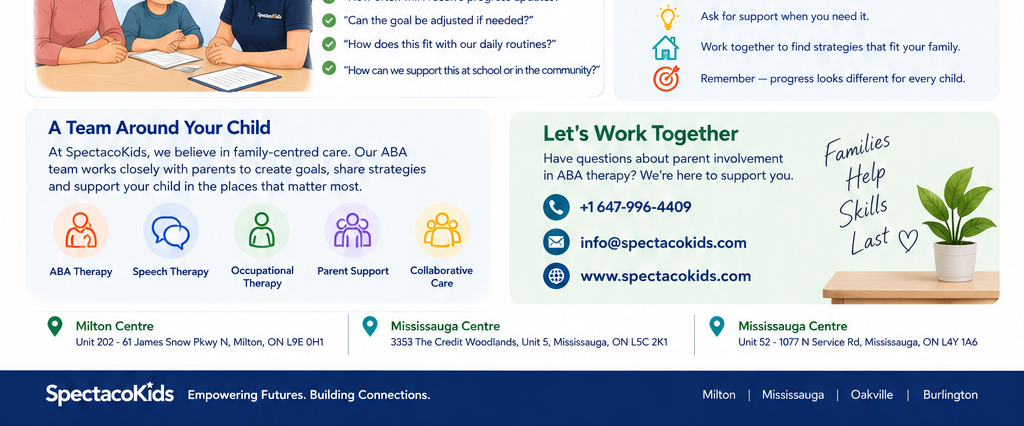
SpectacoKids provides ABA Therapy, Speech Therapy, Occupational Therapy, Psychotherapy, Respite Care, Camps, and Group Classes for children and families. Services are available in-centre and in-home across Milton, Mississauga, Oakville, and Burlington.
For families exploring ABA therapy in Milton Ontario or ABA therapy Mississauga, parent involvement is an important part of understanding the care process.
Parents can contact SpectacoKids to ask about ABA services, parent communication, progress updates, clinical supervision, home strategies, and whether multidisciplinary supports such as Speech Therapy or Occupational Therapy may also help.
Families in Milton and Mississauga can contact SpectacoKids to learn more about ABA services and the care process.
Conclusion
Parent involvement in ABA therapy is not about giving parents more pressure.
It is about building a stronger team around the child.
Parents bring knowledge of daily routines, family priorities, and what life looks like outside the clinic. Therapists bring clinical planning, teaching strategies, data, supervision, and structured support.
When both work together, goals can become more meaningful, strategies can become more realistic, and progress can become easier to carry into everyday life.
Good collaboration should help families feel informed, respected, and supported.
Contact SpectacoKids
Website: www.spectacokids.com
Email: info@spectacokids.com
Phone: +1 647-996-4409
Milton Centre:
Unit 202 – 61 James Snow Pkwy N, Milton, ON L9E 0H1
Mississauga Centre:
3353 The Credit Woodlands, Unit 5, Mississauga, ON L5C 2K1
Mississauga Centre:
Unit 52 – 1077 N Service Rd, Mississauga, ON L4Y 1A6
SpectacoKids lists its contact details, free consultation option, services, and centre locations on the official website.
FAQ Section
Why is parent involvement important in ABA therapy?
Parent involvement helps therapy connect to real life. Parents know their child’s routines, strengths, stress points, and family priorities, which helps the therapy team create goals and strategies that are more practical outside the clinic.
What is ABA parent training?
ABA parent training, sometimes called parent coaching or parent support, helps caregivers understand therapy goals and learn strategies they can use at home, school, and in everyday routines.
Should parents help choose ABA therapy goals?
Yes. Parents should be part of the goal-setting conversation because they understand what matters most in daily family life. Goals should reflect the child’s needs, strengths, and real-world routines.
What questions should parents ask during ABA therapy?
Parents can ask why a goal was chosen, how progress will be measured, what can be practised at home, what to share if something is not working, and whether goals can be adjusted when needed.
Can ABA therapy goals change?
Yes. Goals may change when the child makes progress, family priorities shift, a strategy is not helping, school concerns arise, or the child’s needs change.
How can SpectacoKids support families with ABA therapy?
SpectacoKids provides ABA Therapy, Speech Therapy, Occupational Therapy, Psychotherapy, Respite Care, Camps, and Group Classes, with in-centre and in-home support across Milton, Mississauga, Oakville, and Burlington. Families can contact SpectacoKids to learn more about ABA services and the care process.
References to Add Manually in WordPress
Ontario Autism Program: Core Clinical Services and Supports
Ontario Autism Program: 2026–2027 Core Clinical Services objectives
College of Psychologists and Behaviour Analysts of Ontario: Behaviour Analyst regulation
CanChild: Family-Centred Service in Ontario
SpectacoKids official website and contact page
Social Hashtags
#ParentInvolvement #ABATherapy #AutismParents #SpectacoKids