
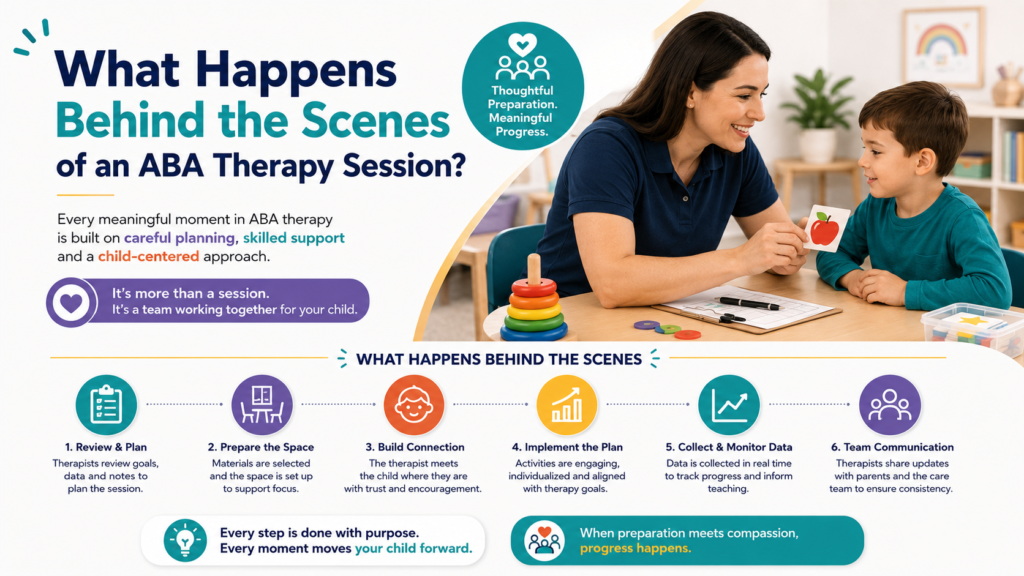
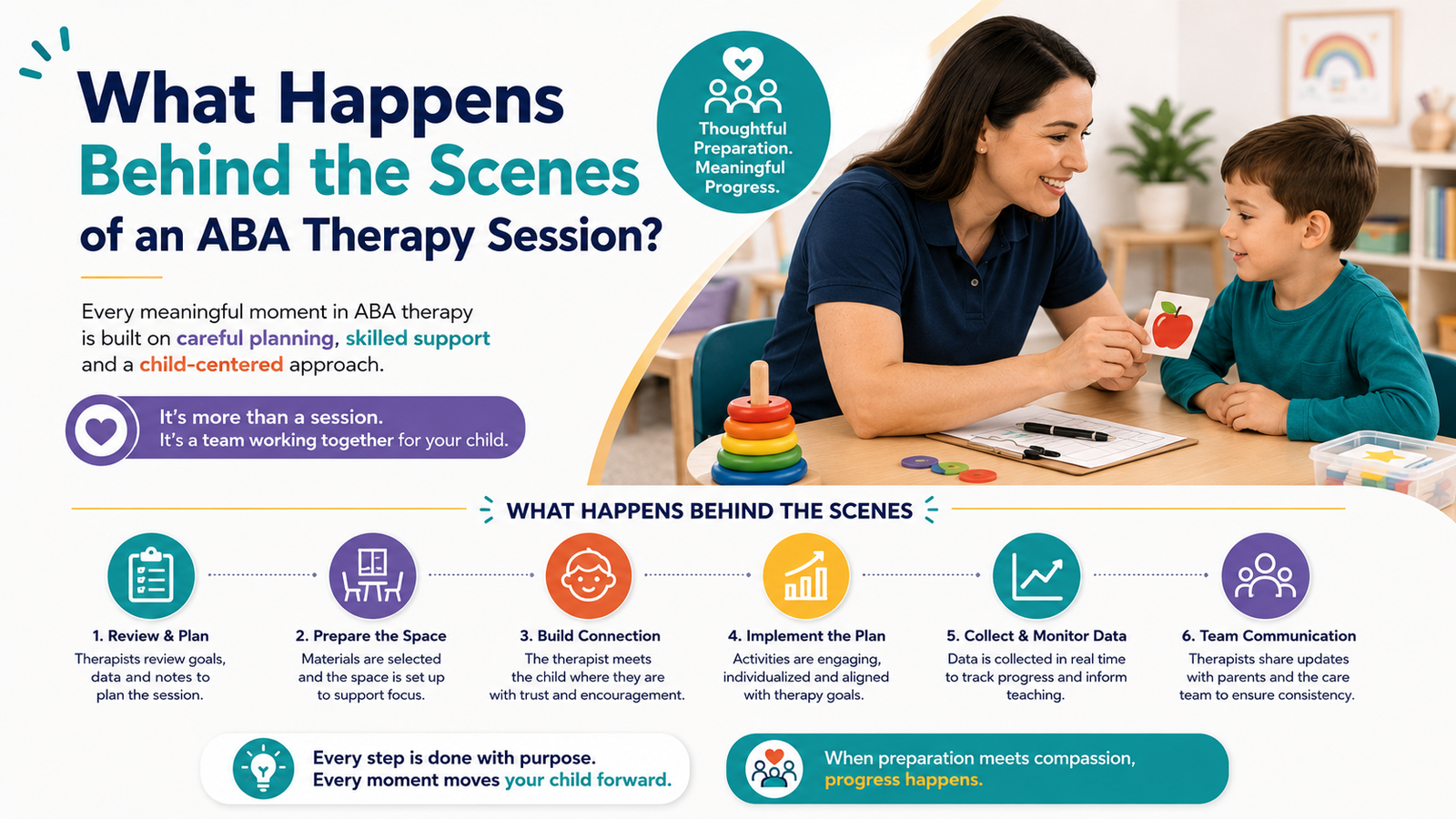
Parents often see the therapy session itself.
They may see a therapist playing with their child, using visual cards, practising communication, giving support during a transition, or writing notes after an activity.
But what parents may not always see is everything that happens around the session.
If you have ever wondered what happens in ABA therapy, the answer is bigger than the time your child spends in the room. A thoughtful ABA therapy session usually includes preparation before the session, active support during the session, and review after the session.
This behind-the-scenes work matters because ABA therapy is not just “activities with a child.” It is a planned, observed, documented, and reviewed process that should connect to the child’s goals, family priorities, communication needs, and treatment plan.
Ontario’s Autism Program describes core clinical services as evidence-informed services that should respond to each child or youth’s unique strengths, needs, opportunities, and goals.
That is why the care process matters.
This article explains what happens before, during, and after an ABA therapy session, and why each step helps create more thoughtful, child-centred support.

ABA Therapy Is More Than the Session You See
An ABA therapy session may look simple from the outside.
A child may be playing with blocks.
A therapist may be using picture cards.
A child may be practising asking for help.
A therapist may be taking notes.
A visual schedule may be sitting nearby.
But each of those details may connect to a bigger goal.
For example, a block activity may support turn-taking, requesting, imitation, waiting, following directions, or flexibility.
A picture card may support communication.
A visual schedule may support transitions.
A short break may support regulation.
A therapist’s notes may help the team understand what worked, what was difficult, and what should happen next.
ABA therapy should be connected to the child’s treatment plan, not random activities.
Ontario’s Autism Program guidance says families work with their chosen clinician to develop a treatment plan, which may include clinical assessment of the child’s current needs and priority goals.
Before the Session: How ABA Session Preparation Happens

Good care starts before the child enters the room.
Before an ABA therapy session, the therapist may review the child’s goals, prepare materials, set up the environment, and make sure visual supports are ready.
This helps the session feel smoother, more purposeful, and more responsive to the child’s needs.
1. Reviewing Goals
Before the session, the therapist reviews the child’s current goals.
These may include goals related to:
Communication
Play skills
Social interaction
Daily living skills
Transitions
Safety skills
Learning readiness
Emotional regulation
Following routines
Reducing behaviours that interfere with learning or safety
The therapist may ask:
What goals are active right now?
What did the child work on last session?
What level of support did the child need?
Was anything difficult last time?
What should we try again today?
What should be adjusted?
This step helps the therapist avoid treating each session like a fresh start with no context.
2. Preparing Materials
ABA session preparation may include choosing materials that match the child’s goals and interests.
Materials may include:
Toys
Books
Picture cards
Visual schedules
First-then boards
Token boards
Sensory tools
Communication supports
Play materials
Data sheets or tablets
Motivating items
Daily living practice items
The materials should not be chosen only because they are colourful or available. They should support the child’s goals.
For example:
A toy car may support requesting, turn-taking, imitation, or pretend play.
A snack activity may support communication, waiting, choice-making, or daily living skills.
A puzzle may support problem-solving, following directions, or asking for help.
A visual schedule may support transitions and predictability.
3. Setting Up the Environment
The environment can affect how a child participates.
Before the session, the therapist may think about:
Is the room too busy?
Are materials organized?
Are distractions reduced?
Is there space for movement?
Is there a calm area if the child needs a break?
Are preferred items available?
Are transitions clear?
Is the setup safe and comfortable?
For some children, a quiet and predictable environment helps them feel ready to participate. For others, movement, play, or sensory supports may be needed before structured learning can happen.
This is why environment setup is part of care, not decoration.
4. Preparing Visual Supports
Visual supports can help many children understand what is happening and what comes next.
Visual supports may include:
First-then boards
Visual schedules
Choice boards
Picture cards
Emotion visuals
Break cards
All done cards
Timer visuals
Step-by-step routine cards
A child who struggles with transitions may benefit from seeing:
First activity, then break.
First table, then toy.
First shoes, then car.
Visual supports can reduce confusion and help the child participate with more confidence.
During the Session: What Happens in ABA Therapy

During the session, the therapist is not only “playing.”
They are watching, teaching, responding, supporting communication, collecting data, and creating opportunities for the child to practise meaningful skills.
1. Building Engagement
Engagement is one of the most important parts of an ABA therapy session.
A child learns better when they feel safe, interested, and connected.
The therapist may begin by following the child’s lead, using preferred toys, offering choices, or joining the child in an activity they already enjoy.
This can help build trust.
Engagement may look like:
Playing together
Taking turns
Following the child’s interest
Offering choices
Using encouraging language
Reducing pressure when needed
Creating small successful moments
Helping the child feel comfortable
A child-centred session does not ignore goals. It builds goals into interactions that make sense for the child.
2. Creating Teaching Opportunities
Teaching opportunities can happen naturally during play and routines.
For example:
A child wants a toy car. The therapist may create an opportunity to request.
A puzzle piece is missing. The therapist may help the child ask for help.
A turn-taking game begins. The child can practise waiting.
A transition is coming. The therapist can use a visual schedule.
A child becomes frustrated. The therapist can support communication or coping.
This is part of how ABA therapy works.
The therapist looks for meaningful moments where the child can practise skills with the right level of support.
3. Supporting Communication
Communication is a major part of many ABA therapy sessions.
Communication does not always mean spoken words.
A child may communicate through:
Words
Sounds
Gestures
Pointing
Pictures
Signs
Communication devices
Facial expressions
Body language
Behaviour
The therapist may support the child in asking for:
Help
More
Break
All done
My turn
Open
Stop
Yes or no
A preferred item
A preferred activity
For some children, reducing frustration starts with giving them a clearer way to communicate.
4. Observing the Child Closely
Observation is happening throughout the session.
The therapist may notice:
What motivates the child
What causes frustration
How the child responds to support
Which prompts are helpful
Which activities are too difficult
How the child communicates
How long the child stays engaged
What happens before challenging behaviour
How the child recovers after a hard moment
Whether the child can use a skill in different activities
These observations help the therapy team make better decisions.
A child’s behaviour is information. It can show what the child understands, what feels hard, what support is needed, and what may need to change.
5. Collecting Data
ABA therapy uses data to understand whether a strategy is working.
Data may track:
How often a skill happens
How much support the child needs
Whether the child uses a skill independently
How often a behaviour occurs
How long a behaviour lasts
What happened before and after behaviour
How the child responds to teaching
Whether progress is happening over time
Data should not replace human understanding. It should support better decision-making.
When data is reviewed properly, it can help answer:
Is this goal still appropriate?
Is the strategy working?
Does the child need more support?
Can support be reduced?
Should the goal be changed?
Is the child using the skill outside therapy?
Ontario’s core clinical service categories include Applied Behaviour Analysis, Speech-Language Pathology, Occupational Therapy, and Mental Health services, which is why some children may benefit from more than one type of support.
After the Session: What Happens When the Child Leaves

The session does not end when the activity ends.
After an ABA therapy session, the therapist may complete documentation, review observations, communicate with the supervisor, prepare future sessions, and share parent updates when appropriate.
1. Documentation
Documentation helps keep the therapy process organized and accountable.
After the session, the therapist may record:
What goals were targeted
What activities were used
How the child responded
What level of prompting was needed
What data was collected
What behaviours were observed
What helped the child succeed
What was difficult
What should be reviewed next
This documentation helps the team understand the child’s progress over time.
2. Reviewing Observations
The therapist may look back at what happened during the session.
They may ask:
Was the child engaged?
Were the goals appropriate?
Did the child need more support than usual?
Did a transition feel difficult?
Was a visual support helpful?
Did communication improve?
Was the environment too distracting?
Should materials change next time?
This reflection helps future sessions become more responsive.
3. Supervisor Communication
ABA therapy should include clinical oversight.
In Ontario, Behaviour Analysts are regulated through the College of Psychologists and Behaviour Analysts of Ontario, and use of the title “Behaviour Analyst” became restricted to College registrants as of July 1, 2024.
Supervisor communication may include:
Sharing data
Reviewing concerns
Discussing progress
Asking clinical questions
Updating goals
Adjusting strategies
Reviewing parent feedback
Planning next steps
Clinical supervision provides professional oversight, review, and accountability.
It does not mean every session will be perfect. It means the therapy process should be monitored and adjusted thoughtfully.
4. Preparing Future Sessions
One session informs the next.
If a strategy worked, the therapist may continue it.
If a child needed more support, the plan may be adjusted.
If a child showed a new interest, that interest may be used next time.
If a goal was too difficult, it may be broken into smaller steps.
If the child showed stress, the team may review how to make the session more comfortable.
Future sessions should build from what the child showed.
This is why behind-the-scenes planning matters.
5. Parent Communication When Appropriate
Parent communication may happen after the session, during scheduled meetings, through session notes, or during progress reviews.
Parents may receive updates such as:
What the child worked on
What went well
What was difficult
What strategy helped
What skill is emerging
What parents can practise at home
What will be reviewed next
Parent communication should be clear and respectful.
Ontario’s service objectives for OAP core clinical services include enhancing the capacity of parents and caregivers, including their knowledge and skills in using support strategies.
That means parent involvement is part of meaningful care, not an extra add-on.
Why This Behind-the-Scenes Work Matters
Parents often judge therapy by what they can see.
But strong care also depends on what happens before and after the visible session.
Behind-the-scenes work helps make sure:
Goals are reviewed
Materials match the plan
The environment supports the child
Visual supports are ready
Communication is supported
Observations are documented
Data is collected
Supervisors can review progress
Future sessions are prepared
Parents receive updates when appropriate
This helps therapy feel less random and more connected to the child’s needs.
It also helps families understand that progress is not built only during one activity. Progress is built through planning, observation, adjustment, communication, and consistency.
What Parents Can Ask About ABA Sessions
Parents should feel comfortable asking questions about how care happens.
Helpful questions include:
What goals will my child work on today?
How do you prepare for each session?
What materials do you use and why?
How do you support communication?
How do you collect data?
Who reviews the data?
How do you decide when to change a goal?
How do you respond if my child becomes overwhelmed?
How will I know what happened in the session?
How can I support the same skill at home?
A transparent provider should be able to explain the session process in plain language.
What If a Session Looks Like Play?
This is a common parent question.
Play can be a powerful part of therapy.
A child may learn communication, turn-taking, waiting, problem-solving, imitation, following directions, flexibility, and social interaction through play.
A session may look playful and still be purposeful.
The key question is not, “Are they just playing?”
The better question is:
“What skill is this activity supporting?”
A good therapist should be able to answer that clearly.
How SpectacoKids Supports the Care Process
SpectacoKids provides ABA Therapy, Speech Therapy, Occupational Therapy, Psychotherapy, Respite Care, Camps, and Group Classes. Services are available in-centre and in-home across Milton, Mississauga, Oakville, and Burlington.
For families exploring ABA therapy in Milton Ontario or ABA therapy Mississauga, understanding what happens before, during, and after sessions can help reduce uncertainty.
At SpectacoKids, families can ask about ABA services, the care process, goals, communication, supervision, parent involvement, and whether other services such as Speech Therapy or Occupational Therapy may also support the child’s needs.
Families in Milton and Mississauga can contact SpectacoKids to learn more about ABA services and the care process.
Conclusion
An ABA therapy session is more than the time a child spends with a therapist.
Before the session, the team may review goals, prepare materials, set up the environment, and organize visual supports.
During the session, the therapist supports engagement, teaching opportunities, communication, observation, and data collection.
After the session, documentation, supervisor communication, future planning, and parent communication help connect one session to the next.
This is how care happens.
Thoughtful therapy is not only what parents see in the room. It is also the preparation, review, and communication that support the child’s progress over time.
Contact SpectacoKids
Website: SpectacoKids official website
Email: info@spectacokids.com
Phone: +1 647-996-4409
Milton Centre:
Unit 202 – 61 James Snow Pkwy N, Milton, ON L9E 0H1
Mississauga Centre:
3353 The Credit Woodlands, Unit 5, Mississauga, ON L5C 2K1
Mississauga Centre:
Unit 52 – 1077 N Service Rd, Mississauga, ON L4Y 1A6
SpectacoKids lists its contact details, free consultation option, services, and centre locations on the official website.
Suggested Internal Links to Add in WordPress
ABA Therapy
Meet the Team
Contact
Milton location
Mississauga location
Speech Therapy
Occupational Therapy
Resources
FAQ Section
What happens in ABA therapy?
ABA therapy may include goal-based teaching, communication support, play-based learning, observation, data collection, and progress review. A session should connect to the child’s treatment plan and real-life goals.
What happens before an ABA therapy session?
Before a session, the therapist may review goals, prepare materials, set up the environment, and organize visual supports so the session is purposeful and child-friendly.
What happens during an ABA therapy session?
During a session, the therapist may build engagement, create teaching opportunities, support communication, observe behaviour and learning patterns, and collect data.
What happens after an ABA therapy session?
After a session, the therapist may complete documentation, review observations, communicate with the supervisor, prepare future sessions, and update parents when appropriate.
Why is data collected in ABA therapy?
Data helps the therapy team understand whether a strategy is working, whether progress is happening, and whether goals or supports need to change.
Should parents receive updates after ABA sessions?
Parents should understand how communication works before services begin. Updates may happen through session notes, meetings, verbal summaries, parent coaching, or progress reviews depending on the provider’s process.