

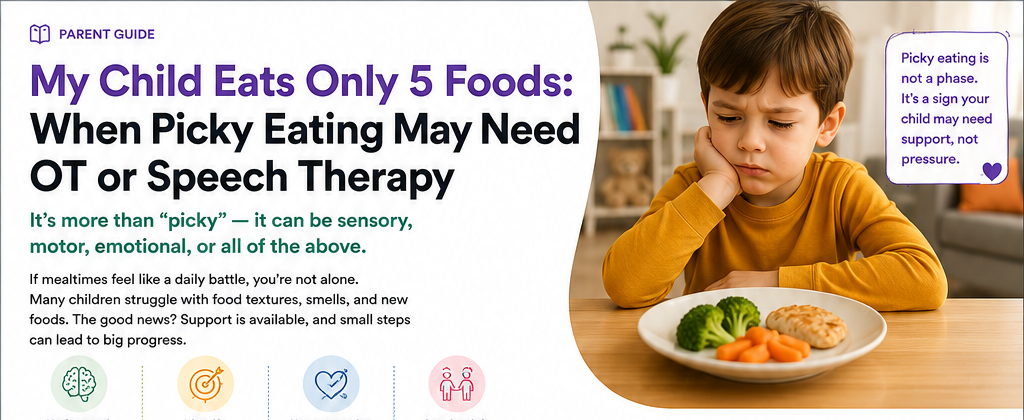
Mealtimes should not feel like a daily battle.
But for many families, food becomes one of the most stressful parts of the day.
Your child may only eat the same five foods.
They may refuse anything new.
They may gag when a food looks, smells, or feels different.
They may panic if two foods touch on the plate.
They may eat well one week and suddenly refuse the same food the next.
Parents often hear, “They’re just picky,” or “They’ll eat when they’re hungry.”
Sometimes picky eating is part of normal development. But sometimes, a child’s limited eating may be connected to sensory processing, oral-motor challenges, anxiety, routine, medical concerns, or developmental differences.
This blog explains when picky eating may need extra support, what signs parents should watch for, and how Occupational Therapy, Speech Therapy, and ABA Therapy can help children build a calmer and healthier relationship with food.
When Is Picky Eating More Than Just “Picky”?
Many children go through phases where they refuse vegetables, prefer familiar foods, or want the same meal again and again.
That can be normal.
AboutKidsHealth, a SickKids health education resource, explains that young children may sometimes refuse foods or only want a small number of foods as they are introduced to more variety. It also recommends speaking with a health-care provider if parents are very concerned about their child’s eating habits, growth, or nutrition.
Picky eating may need more attention when it affects:
Nutrition
Growth
Family stress
Daily routines
School or daycare participation
Social events
The child’s confidence
The child’s ability to try new foods safely
A child who eats only a few foods may not simply be stubborn. Their body may be reacting to something that feels uncomfortable, unpredictable, overwhelming, or unsafe.
Signs Your Child May Need Extra Feeding Support
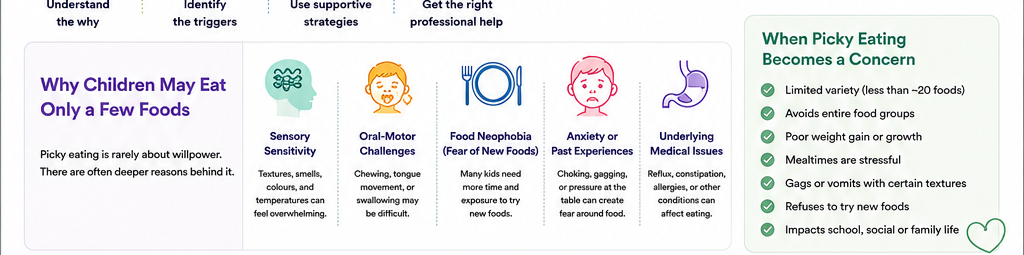
Consider professional support if your child:
Eats only a very small variety of foods
Refuses entire food groups such as fruits, vegetables, proteins, or mixed foods
Gags, vomits, coughs, or shows strong reactions to certain textures
Avoids foods based on smell, colour, brand, shape, or temperature
Becomes extremely upset when new foods are presented
Takes a very long time to eat
Struggles to chew, move food around, or swallow safely
Avoids sitting at the table
Shows poor appetite or weight concerns
Has stressful mealtimes almost every day
Becomes anxious when food routines change
Only accepts foods prepared in one exact way
These signs do not automatically mean something serious is wrong. But they do mean the child may benefit from a closer look.
What Might Be Behind Food Refusal?
Food is not just taste.
Food involves smell, texture, temperature, colour, sound, movement, body awareness, chewing, swallowing, routine, emotion, and safety.
That is why feeding challenges can have more than one cause.
1. Sensory Processing Differences
For some children, certain food textures, smells, colours, or temperatures feel overwhelming.
A banana may feel too mushy.
A cracker may sound too loud.
A mixed food may look unpredictable.
A strong smell may make the child gag.
A sauce may feel uncomfortable on the tongue.
Autism Speaks notes that many autistic children and adults may be highly sensitive to flavour, colour, smell, and texture, and that food-related challenges often overlap with sensory sensitivities and difficulty with change.
Even when a child is not autistic, sensory sensitivity can still affect eating.
2. Oral-Motor Challenges
Some children struggle with the physical skills needed for eating.
They may have difficulty:
Chewing
Biting
Moving food with the tongue
Managing mixed textures
Drinking from a cup or straw
Swallowing safely
Handling foods that require more strength or coordination
If eating feels hard, tiring, or uncomfortable, the child may prefer foods that are easier to manage.
For example, they may prefer soft processed foods, crunchy snacks that dissolve quickly, or foods that always feel the same.
3. Past Negative Experiences
A child may avoid food after choking, gagging, vomiting, reflux, pressure at the table, or a stressful mealtime experience.
Even one difficult experience can make some children more cautious.
If a child remembers that a food felt scary, they may refuse it before it even touches their mouth.
4. Anxiety and Control
Some children feel safer when food is predictable.
Same plate.
Same brand.
Same shape.
Same texture.
Same colour.
Same routine.
When a new food appears, it may feel like a loss of control.
This is why pressure often backfires. The more adults push, the more anxious the child may become.
5. Routine and Rigidity
Some children rely heavily on routine.
They may eat chicken nuggets only from one brand.
They may accept pasta only without sauce.
They may eat toast only if it is cut a certain way.
They may reject yogurt if the container design changes.
This may look unreasonable to adults, but for the child, the difference may feel big.
6. Medical Concerns
Sometimes eating difficulties may be related to reflux, constipation, allergies, oral pain, swallowing concerns, or other medical issues.
Parents should speak with a health-care provider if they notice poor growth, weight loss, coughing or choking during meals, vomiting, pain, ongoing constipation, or major nutrition concerns.
Why Pressure Can Make Picky Eating Worse
Many parents try pressure because they are worried.
“Just take one bite.”
“You can’t leave until you try it.”
“You liked this last week.”
“Your brother eats it.”
“No dessert unless you eat this.”
These responses are understandable, but they can make mealtimes more stressful.
HealthyChildren.org, from the American Academy of Pediatrics, recommends a low-key approach for picky eaters and encourages repeated exposure to foods without turning meals into battles.
For children with sensory or feeding challenges, pressure can increase anxiety and reduce trust.
A better goal is not forcing food immediately.
A better goal is helping the child feel safe around food first.
Small Food Wins That Still Count
Progress does not always begin with eating.
For some children, progress may look like:
Looking at a new food
Sitting near a new food
Smelling a new food
Touching a food with one finger
Holding a food
Putting it on their plate
Licking it
Taking a tiny bite
Chewing and spitting safely
Tolerating a new food at the table
Eating a familiar food in a slightly different shape
These steps may seem small, but they can be meaningful.
A child who is scared of food needs trust before variety.
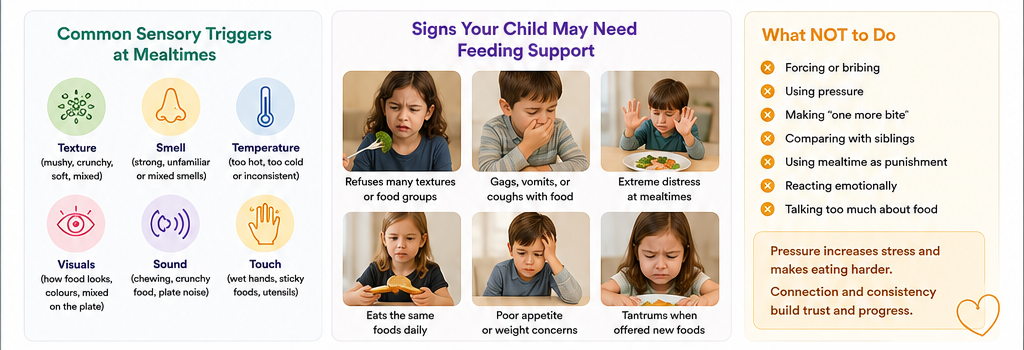
How Occupational Therapy Can Help With Picky Eating
Occupational Therapy can help when picky eating is connected to sensory processing, body awareness, fine motor skills, oral exploration, mealtime routines, self-feeding, or daily independence.
An occupational therapist may look at:
How the child responds to smell, touch, texture, and temperature
How the child sits at the table
Whether the child can use utensils
Whether the child has enough body stability for eating
How the child handles messy play
How the child reacts to mixed textures
What routines make mealtimes easier or harder
What sensory supports may help before meals
Holland Bloorview Kids Rehabilitation Hospital lists feeding services for children and youth with feeding and swallowing issues, with therapy strategies provided by speech-language pathologists and/or occupational therapists.
OT support may include:
Sensory food exploration
Food play away from pressure
Touching, smelling, and interacting with food
Building tolerance for textures
Improving self-feeding skills
Supporting posture and seating
Helping with mealtime routines
Parent coaching
Creating calmer eating environments
The goal is not to force the child to eat everything.
The goal is to help the child feel safer, more capable, and more comfortable around food.
How Speech Therapy Can Help With Feeding
Speech Therapy is often known for communication, but speech-language pathologists can also support feeding-related skills when eating involves oral-motor, chewing, swallowing, or communication challenges.
Speech therapy may help with:
Chewing skills
Tongue and lip movement
Oral-motor coordination
Safe swallowing concerns
Drinking skills
Food progression
Communication around wants and needs
Reducing frustration at meals
Helping children ask for help, more, all done, or break
SpectacoKids lists Speech Therapy as support for communication, language, articulation, and feeding skills.
This matters because some children refuse foods not because they dislike them, but because their mouth and body do not know how to manage them comfortably.
How ABA Therapy Can Help With Mealtime Routines
ABA Therapy can support children when mealtime challenges are connected to routines, behaviour patterns, communication, transitions, or skill-building.
ABA support may help with:
Increasing tolerance around food
Teaching communication during meals
Reducing refusal behaviours
Building step-by-step mealtime routines
Using visual supports
Supporting transitions to the table
Helping children sit for short, successful periods
Reinforcing small, meaningful progress
Helping skills carry over at home, school, and community settings
SpectacoKids’ ABA Therapy page lists feeding among the skills that may be taught using strategies based on ABA principles.
A respectful ABA approach should not be about forcing bites. It should be about understanding why the child is struggling and building skills gradually.
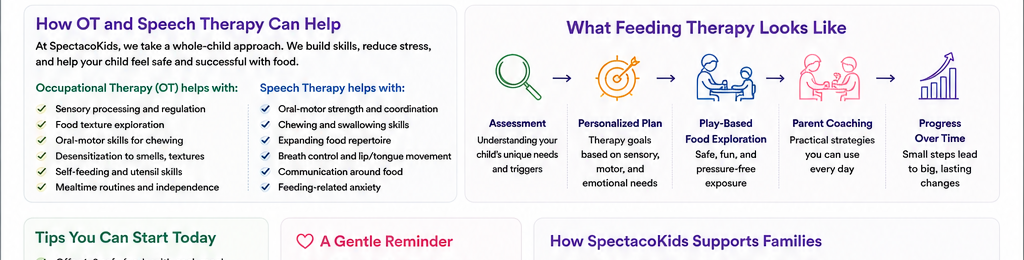
What Parents Can Try at Home
These strategies are not a replacement for therapy, but they can help make mealtimes calmer.
1. Keep One Safe Food on the Plate
A safe food is something your child usually eats.
When trying a new food, do not remove all familiar foods. That can increase stress.
Try:
One safe food
One learning food
No pressure to eat the new food
For example:
Crackers plus cucumber
Rice plus tiny carrot piece
Toast plus a small fruit slice
Pasta plus a new sauce on the side
2. Let Food Exploration Happen Away From Meals
Some children are more willing to explore food when they are not expected to eat it.
Try food play outside mealtime:
Washing fruits
Stirring yogurt
Making faces with vegetables
Touching dry pasta
Smelling herbs
Putting food in containers
Pretend cooking
Sorting foods by colour
This helps the child build comfort before eating is expected.
3. Avoid Turning Every Meal Into Therapy
Not every meal needs to become a challenge.
Children need some meals where they can simply eat and feel safe.
Choose specific moments for exploration, not every single bite.
4. Use Small Portions
A large portion of a new food can feel overwhelming.
Use tiny amounts.
A pea-sized piece.
A small lick.
One noodle.
One crumb.
One dot of sauce.
Small feels safer.
5. Model Without Pressure
Children learn by watching.
Eat the food calmly near them. Avoid making a big performance.
Instead of saying, “You have to try this,” try:
“I’m eating mine.”
“This is crunchy.”
“I’m going to smell it.”
“You can leave yours on the plate.”
6. Keep Mealtimes Predictable
Predictability helps many children feel safer.
Use a simple routine:
Wash hands
Sit down
Safe food
Learning food nearby
Drink
Clean up
All done
Visual schedules can also help children understand what is happening.
7. Celebrate Tiny Steps
Do not celebrate only swallowing.
Celebrate:
Sitting at the table
Smelling a food
Touching a food
Keeping a food on the plate
Trying a new cup
Using a spoon
Asking for help
Staying calm near a new food
Tiny steps can lead to bigger progress.
What Not to Do
Try to avoid:
Forcing bites
Bribing with dessert
Punishing food refusal
Comparing siblings
Hiding foods without the child knowing
Making mealtime a test
Commenting constantly on how much the child eats
Reacting strongly when the child refuses
Using food as a reward or punishment
The goal is to reduce stress, not increase it.
When Should Parents Seek Professional Help?
Consider reaching out for support if:
Your child eats fewer than 10 to 20 foods
Your child avoids entire food groups
Mealtimes cause daily stress
Your child gags, vomits, or coughs often
Your child is not gaining weight or growing as expected
Your child has trouble chewing or swallowing
Your child avoids eating at school or social events
Your child eats only one texture or brand
Your child becomes highly distressed around new foods
Home strategies are not helping
If there are concerns about growth, nutrition, pain, vomiting, choking, or swallowing, speak with your child’s physician or health-care provider.
What a Therapy Plan May Look Like
A therapy plan may include:
Parent interview
Observation of eating patterns
Sensory profile review
Oral-motor screening
Food list review
Mealtime routine planning
Safe food and learning food strategy
Gradual food exploration
Visual supports
Parent coaching
Home practice steps
Collaboration with other providers when needed
For some children, OT may be the main support.
For others, Speech Therapy may be needed.
Some children may benefit from ABA support as well.
Some may need medical or nutrition guidance first.
The right plan depends on the child.
A Gentle Reminder for Parents
If your child eats only a few foods, it can feel scary.
You may worry about nutrition, growth, school lunches, family meals, birthday parties, restaurants, and whether your child will ever try something new.
But your child is not trying to make life difficult.
They may be overwhelmed.
They may feel unsafe around food.
They may not have the oral-motor skills yet.
They may need predictability.
They may need support to build trust.
Progress can happen.
Slowly.
Respectfully.
One small step at a time.
How SpectacoKids Can Help
SpectacoKids provides ABA Therapy, Speech Therapy, Occupational Therapy, Psychotherapy, Respite Care, ABA-based Camps, and Social Skills Group Classes for children and families. Services are available in-centre and in-home across Milton, Mississauga, Oakville, and Burlington.
If your child eats only a few foods, refuses textures, struggles with chewing, gags often, avoids mealtimes, or becomes distressed around food, a free consultation can help your family understand the next best step.
Support may involve Occupational Therapy, Speech Therapy, ABA Therapy, or a combination of services depending on your child’s needs.
Your child deserves a calmer relationship with food.
And your family does not have to figure it out alone.
Contact SpectacoKids
Website: www.spectacokids.com
Email: info@spectacokids.com
Phone: +1 647-996-4409
Locations:
Milton Centre
Unit 202 – 61 James Snow Pkwy N, Milton, ON L9E 0H1
Mississauga Centre
3353 The Credit Woodlands, Unit 5, Mississauga, ON L5C 2K1
Mississauga Centre
Unit 52 – 1077 N Service Rd, Mississauga, ON L4Y 1A6
SpectacoKids lists its phone number, email, consultation option, and centre locations on the official contact page.
Follow SpectacoKids:
Instagram: @spectacokids
Facebook: SpectacoKids
LinkedIn: SpectacoKids
Book a free consultation through the SpectacoKids website.
FAQ Section for Google and AI Search
Why does my child only eat a few foods?
A child may eat only a few foods because of sensory sensitivities, oral-motor challenges, anxiety, routine, past negative experiences, or medical concerns. It is not always simple picky eating.
When should I worry about picky eating?
Parents should seek guidance if their child eats very few foods, avoids food groups, gags often, loses weight, struggles with growth, coughs during meals, avoids chewing, or experiences major stress at mealtimes.
Can Occupational Therapy help with picky eating?
Yes. Occupational Therapy can help when picky eating is connected to sensory processing, food textures, self-feeding, posture, body awareness, and mealtime routines.
Can Speech Therapy help with feeding?
Yes. Speech Therapy may help when a child has difficulty chewing, swallowing, using oral-motor skills, drinking, or communicating needs during meals.
Can ABA Therapy help with mealtime behaviour?
ABA Therapy can help identify mealtime patterns, teach communication, build routines, reduce refusal behaviours, and support gradual skill-building around food.
Should I force my child to try new foods?
Forcing food can increase stress and make mealtimes harder. A calmer approach usually starts with safety, exposure, modelling, small steps, and professional guidance when needed.