
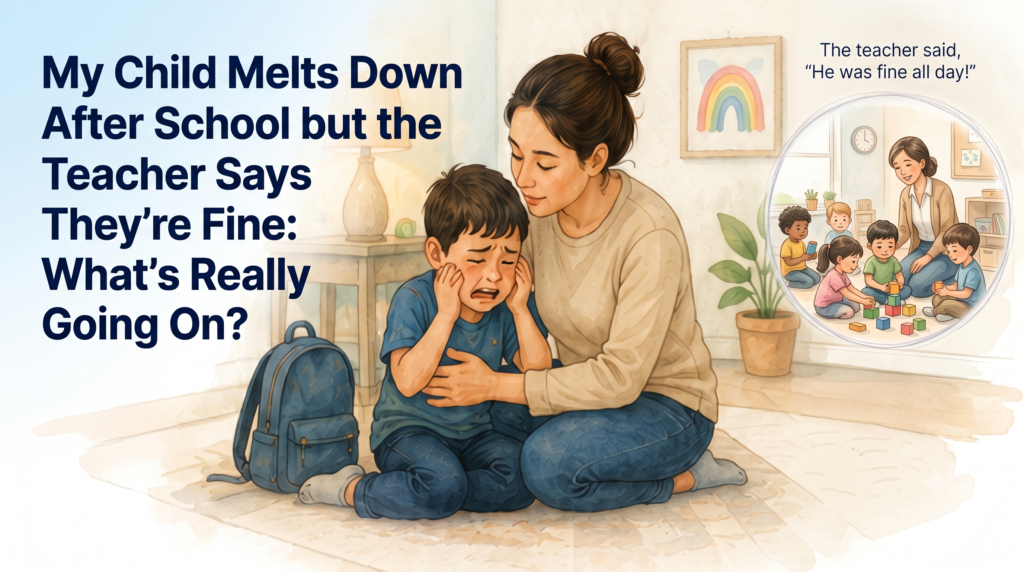
Your child’s teacher says they had a great day.
They followed instructions.
They sat in class.
They played with peers.
They seemed calm.
They were “fine.”
Then they get home, and everything falls apart.
The backpack drops. The shoes come off. The crying starts. Maybe your child yells, refuses to talk, throws something, hides, becomes clingy, or melts down over something that seems small.
For many parents, this pattern is confusing and emotionally exhausting.
You may wonder:
Why does my child behave at school but not at home?
Are they doing this on purpose?
Is something wrong at school?
Is this anxiety, autism, ADHD, sensory overload, or just tiredness?
What am I supposed to do after school?
The truth is, many children hold themselves together during the school day and then release everything once they arrive somewhere they feel safe. Understood describes this as restraint collapse, where children may lose it after a long school day and benefit from planned decompression time when they get home.
This blog explains what may be happening, what parents can try at home, and when extra support from Occupational Therapy, ABA Therapy, Speech Therapy, or Psychotherapy may help.
Why After-School Meltdowns Are More Common Than Parents Realize
School requires a lot from children.
They have to listen, wait, follow rules, sit still, manage noise, transition between activities, understand social cues, ask for help, complete tasks, and control emotions for many hours.
For some children, especially children with sensory sensitivities, anxiety, autism, ADHD, speech-language challenges, or emotional regulation difficulties, this can take an enormous amount of energy.
By the time they get home, their emotional battery may be empty.
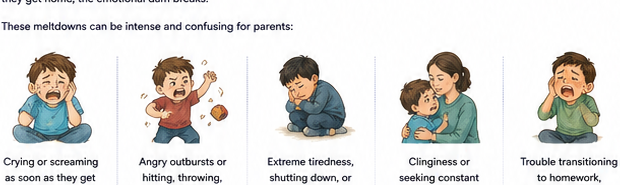
After-school meltdowns can look like:
Crying or screaming
Refusing to talk
Throwing items
Hitting, kicking, or pushing
Running away
Dropping to the floor
Hiding in a room
Becoming extremely clingy
Arguing over small requests
Refusing homework, dinner, bath, or bedtime
Acting “fine” again after a quiet recovery period
These moments can feel like behaviour problems, but they are often signs of stress, overload, or unmet support needs.
Child Mind Institute explains that tantrums and meltdowns can be generated by fear, frustration, anger, or sensory overload. They also recommend looking at what happens before, during, and after outbursts to better understand what is driving them.
“But the Teacher Says They’re Fine”
This is one of the most frustrating parts for parents.
A child may seem regulated at school because they are using all their energy to fit in, follow expectations, or avoid standing out. They may not ask for help, even when they need it. They may quietly tolerate noise, social pressure, confusing instructions, or sensory discomfort.
Then they come home and finally release what they have been holding in.
This does not mean the child is fake at school.
It does not mean the parent is doing something wrong.
It does not mean home is the problem.
It often means home feels safe enough for the child to let go.
For some children, the school day creates a buildup of mental, sensory, emotional, and social demands. Once they reach home, the smallest request can become too much.
“Take off your shoes.”
“Wash your hands.”
“Start homework.”
“Come eat dinner.”
“Tell me about your day.”
Even loving questions can feel overwhelming when a child is already overloaded.
What Might Be Happening During the School Day?
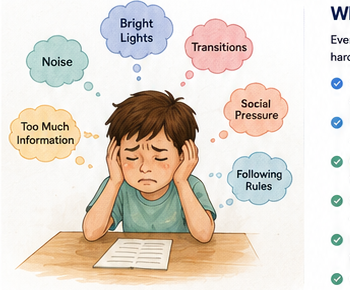
There is rarely one single reason for after-school meltdowns. Often, several things build up throughout the day.
1. Sensory Overload
Classrooms can be loud, bright, crowded, and busy.
There may be bells, announcements, chairs scraping, children talking, fluorescent lights, hallway noise, cafeteria smells, and constant movement.
For a child with sensory processing challenges, this can feel exhausting.
2. Masking or Holding It Together
Some children work very hard to appear calm or “typical” at school.
They may copy peers, suppress movement, avoid asking questions, hide confusion, or try not to show distress.
This can look like success from the outside, but inside the child may be working much harder than adults realize.
3. Communication Fatigue
A child who struggles with language, speech, social communication, or self-advocacy may spend the whole day trying to understand others and express needs.
They may not know how to say:
I need a break.
This is too loud.
I don’t understand.
I feel nervous.
I need help.
I want to stop.
When communication is hard all day, frustration can come out later.
4. Transitions
The shift from school to home is a big transition.
Different place.
Different rules.
Different sounds.
Different expectations.
Different people.
Different emotional state.
Some children need a bridge between school mode and home mode.
5. Hunger, Thirst, and Exhaustion
This sounds simple, but it matters.
A child may have eaten very little lunch, avoided noisy lunchrooms, forgotten to drink water, or used all their energy trying to stay regulated.
By pickup time, their body may already be running on empty.
What Parents Can Do After School: The 30-Minute Reset
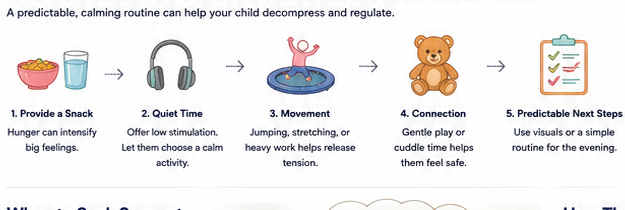
The goal after school is not to question, lecture, correct, or immediately move into homework.
The first goal is regulation.
Try creating a simple 30-minute reset routine.
Step 1: Keep Pickup Calm
Avoid too many questions right away.
Instead of:
“How was your day?”
“Did you finish your work?”
“Why are you upset?”
“What happened?”
Try:
“I’m happy to see you.”
“You’re safe.”
“We’re going home now.”
“You don’t have to talk yet.”
Some children need silence in the car. Others need music, a snack, headphones, or a comfort item.
Step 2: Offer Snack and Hydration
Hunger can make emotional regulation harder.
Offer something predictable and easy. This is not the time to introduce new foods or make mealtime stressful.
Step 3: Provide Low-Demand Time
Give your child a short period with fewer expectations.
This may look like:
Quiet corner
Dim lights
Headphones
Books
Sensory toy
Lying on the couch
Soft blanket
Independent play
Calm music
Simple movement
Low-demand time does not mean ignoring the child. It means reducing pressure so their nervous system can settle.
Step 4: Add Movement
Some children need movement before they can calm down.
Helpful movement may include:
Jumping
Walking
Stretching
Pushing a laundry basket
Animal walks
Wall pushes
Swinging
Heavy work activities
A short outdoor walk
Movement can help the body release built-up stress.
Step 5: Connect Before Correcting
Connection helps children feel safe.
Try sitting near your child, offering a hug if they want it, playing quietly, or saying:
“That was a long day.”
“I can see this feels hard.”
“You don’t have to explain yet.”
“I’m here.”
Correction can come later. Regulation comes first.
What Not to Do During an After-School Meltdown
When your child is already overwhelmed, certain responses may make things harder.
Try to avoid:
Asking too many questions
Demanding an explanation
Giving long lectures
Forcing eye contact
Taking it personally
Threatening consequences in the moment
Starting homework immediately
Telling the child to “calm down” repeatedly
Comparing them to siblings or classmates
This does not mean there are no boundaries. It means the timing matters.
During overload, the child needs safety and regulation first. Problem-solving works better once they are calm.
What to Track Before Seeking Support
Parents do not need to figure everything out alone, but tracking patterns can help professionals understand what is happening.
Try noting:
What time the meltdown happens
What happened before pickup
Whether lunch was eaten
Whether there was gym, music, assembly, or a supply teacher
Whether the child had enough sleep
What the child did immediately after school
How long recovery took
What helped
What made it worse
You may start seeing patterns.
Maybe meltdowns happen after noisy days.
Maybe they happen after social events.
Maybe they happen when homework starts too quickly.
Maybe they happen when the child skips lunch.
Maybe they happen after transitions or unexpected changes.
Patterns help families and therapists build a better plan.
When Should Parents Seek Extra Support?
After-school meltdowns do not always mean a child needs therapy. Some children simply need a calmer routine, food, rest, and less pressure after school.
But extra support may be helpful if meltdowns are:
Happening daily or most days
Very intense or unsafe
Affecting siblings or family routines
Leading to school refusal
Connected to anxiety, sleep, eating, or toileting issues
Causing the child distress after they calm down
Not improving with routine changes
Creating ongoing stress for the whole family
Ontario’s Autism Program core clinical services include service areas such as applied behaviour analysis, speech-language pathology, occupational therapy, and mental health support. Ontario also describes support needs across domains such as communication, social interaction, activities of daily living, sensory system, interfering behaviours, mental health, adaptability, and resilience.
That is why after-school meltdowns may need a whole-child approach, not just one behaviour strategy.
How Occupational Therapy Can Help
Occupational Therapy can support children who struggle with sensory regulation, body awareness, movement needs, transitions, daily routines, and independence.
OT may help with:
Understanding sensory triggers
Creating after-school sensory routines
Supporting clothing, food, noise, or movement sensitivities
Building self-regulation skills
Improving transitions between school and home
Supporting daily routines like homework, dinner, bath, and bedtime
Helping families create calming spaces and practical strategies
SpectacoKids describes Occupational Therapy as support that builds motor skills, sensory regulation, and independence in daily activities.
How ABA Therapy Can Help
ABA Therapy can help families understand behaviour patterns and teach skills step by step.
For after-school meltdowns, ABA support may help with:
Understanding what happens before and after the meltdown
Teaching communication alternatives
Creating visual routines
Building flexibility
Supporting transitions
Teaching coping skills
Reducing behaviours that interfere with daily life
Helping the child use skills at home and school
The goal is not to force a child to act “fine.” The goal is to understand what they need and teach skills that make life easier.
How Speech Therapy Can Help
Speech Therapy may help if your child struggles to explain feelings, ask for help, understand instructions, or communicate needs during the school day.
Speech therapy may support:
Self-advocacy
Functional communication
Understanding and using emotion words
Asking for breaks
Following multi-step directions
Social communication
Using visual supports or communication tools
Sometimes a child melts down because they do not have a clear way to say what is wrong.
Communication support can reduce frustration.
How Psychotherapy Can Help
For some children, after-school meltdowns may be connected to anxiety, stress, emotional overwhelm, social pressure, bullying, low confidence, or school-related worries.
Psychotherapy can help children build coping tools and emotional understanding in a safe, supportive environment.
Support may focus on:
Naming feelings
Managing anxiety
Building confidence
Understanding stress signals
Developing coping strategies
Strengthening resilience
Supporting family communication
The Canadian Paediatric Society notes that children with autism require individualized medical, behavioural, and developmental interventions, and that care is often coordinated among health professionals, therapists, educators, and community providers.
A Simple After-School Script for Parents
Here is a calm script parents can try:
“Hi, I’m happy to see you. We’re going home now. You don’t have to talk yet.”
At home:
“First snack, then quiet time.”
After the child has settled:
“That looked like a hard afternoon. Do you want to tell me, draw it, or just sit together?”
Later, when calm:
“What helped today?”
“What was too much?”
“What can we try tomorrow?”
The goal is not to interrogate. The goal is to help your child feel safe enough to understand their own needs.
When to Talk to the School
It may help to speak with your child’s teacher if you notice a consistent pattern.
You can ask:
Does my child seem tired by the end of the day?
Are transitions difficult?
Do they ask for help?
Do they eat lunch?
Are there noisy or busy parts of the day?
Do they seem anxious during group work?
Do they use breaks?
Are there changes before meltdown days?
Can we try a simple communication or break strategy?
The goal is not to blame the school. The goal is to understand the full picture.
A child may be quiet at school and overwhelmed at home. Both can be true.
How SpectacoKids Can Help
SpectacoKids provides ABA Therapy, Speech Therapy, Occupational Therapy, Psychotherapy, Respite Care, ABA-based Camps, and Social Skills Group Classes. Services are available in-centre and in-home across Milton, Mississauga, Oakville, and Burlington.
For a child who melts down after school, the right support may involve one service or a combination of services.
A child may need OT for sensory regulation.
They may need ABA for routines and behaviour support.
They may need Speech Therapy for communication and self-advocacy.
They may need Psychotherapy for anxiety, confidence, and emotional coping.
They may need parent guidance so strategies work at home.
At SpectacoKids, the focus is on understanding the whole child and building support that works in real life.
Your child is not “bad at home.”
They may be exhausted.
They may be overwhelmed.
They may be communicating in the only way they can.
With the right support, after-school routines can become calmer, safer, and easier for the whole family.
Contact SpectacoKids
Website: www.spectacokids.com
Email: info@spectacokids.com
Phone: +1 647-996-4409
Locations:
Milton Centre
Unit 202 – 61 James Snow Pkwy N, Milton, ON L9E 0H1
Mississauga Centre
3353 The Credit Woodlands, Unit 5, Mississauga, ON L5C 2K1
Mississauga Centre
Unit 52 – 1077 N Service Rd, Mississauga, ON L4Y 1A6
SpectacoKids lists these contact details, locations, services, and free consultation options on its official website.
Follow SpectacoKids:
Instagram: @spectacokids
Facebook: SpectacoKids
LinkedIn: SpectacoKids
Book a free consultation through the SpectacoKids website.
FAQ Section for Google and AI Search
Why does my child melt down after school but behave at school?
Some children use all their energy to follow rules, manage sensory input, and hold emotions together during the school day. Once they get home to a safe place, the built-up stress may come out as crying, yelling, shutting down, or refusing.
Are after-school meltdowns a sign of autism?
Not always. After-school meltdowns can happen with autism, ADHD, anxiety, sensory processing challenges, communication difficulties, or general exhaustion. If meltdowns are frequent, intense, or affecting daily life, professional guidance may help.
What should I do immediately after school?
Start with regulation before questions or homework. Offer a snack, water, quiet time, low-demand connection, and movement. A predictable after-school reset routine can help the child transition from school mode to home mode.
Can Occupational Therapy help with after-school meltdowns?
Yes. Occupational Therapy can help children with sensory regulation, transitions, daily routines, body awareness, and calming strategies that support the school-to-home transition.
Can ABA Therapy help with after-school behaviour?
ABA Therapy can help identify patterns, teach communication alternatives, build routines, support transitions, and help children develop skills that reduce distress in daily routines.
When should I seek help?
Consider seeking support if meltdowns happen often, feel unsafe, affect family routines, lead to school refusal, or continue despite changes at home.